
NASCAR Hall of Famer diagnosed with CTE
First known case in racecar driver
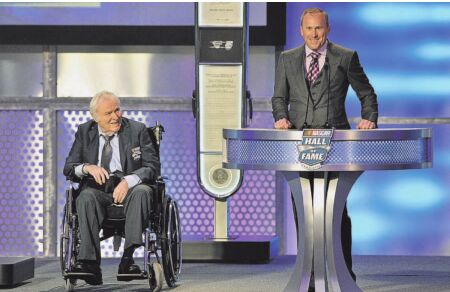
Chris Lorenzen (right) talks about father Fred at the 2015 NASCAR Hall of Fame ceremony. (LANCE KING / GETTY IMAGES FILES)
CHARLOTTE, N.C. — NASCAR Hall of Fame driver Fred Lorenzen has been diagnosed with Chronic Traumatic Encephalopathy, a brain disease otherwise known as CTE.
His diagnosis is the first known case of CTE in a NASCAR driver, according to the Concussion & CTE Foundation.
Lorenzen's family shared the results of his post-mortem brain tissue analysis through the foundation on Tuesday. Researchers at the Boston University CTE Center officially diagnosed Lorenzen with Stage 3 CTE, the second-most severe of four stages.
Lorenzen died on Dec. 18, 2024, at 89 years old, after living with dementia for 20 years, according to the family. CTE can only be discovered after death.
In light of the announcement, Lorenzen's children have made a US$1-million donation to the Concussion and CTE Foundation. The donation seeks to create the Fred Lorenzen Memorial HelpLine to help struggling drivers and their families find care.
The news comes when neurological degenerative conditions are on the minds and hearts of the racing community. About a month ago, the family of another NASCAR Hall of Famer, Darrell Waltrip, announced that he had been diagnosed with Frontotemporal Degeneration and thus would be stepping away from the public spotlight.
The family said the diagnosis likely stemmed from his racing career — one in which drivers raced like gladiators without safety protections that have been in place the past two decades.
Waltrip's family wrote in a statement that the diagnosis could be "complicated by possible" CTE. They added: "Be assured, Darrell is happy and otherwise healthy, spending time with his wife, Stevie, two daughters and three young grandchildren. We are grateful for your continued prayer, love and support."
Lorenzen has a long list of accomplishments in his racing career. He also had a trove of nicknames, from Fast Freddie to Fearless Freddy to Golden Boy to the Elmhurst Express, a tribute to his Illinois hometown.
The man of many names was among the best racers in NASCAR history. From 1961-67, he won 26 races — more than David Pearson and Richard Petty in that time. He was the first driver in series history to earn US$100,000 in prize money in a season. The 1965 Daytona 500 winner was voted NASCAR's most popular driver in 1963 and 1965 — and was listed as one of NASCAR's 50 all-time greatest drivers.
He was inducted into the Hall of Fame in 2015.
His daughter, Amanda, told the Charlotte Observer prior to his induction that Lorenzen rarely talked about his career. He was humble, Amanda said. The induction gave his children a unique chance to celebrate him.
"As a daughter, it's unbelievable," she said. "In the Midwest, you don't hear as much about racing as you do down there. I'll cry. I want Dad to know that we know (how great of a racer he was). The secret's out."
A career in racing meant a large toll on Lorenzen's body and brain. Concussions remain a recurring discussion in the sport — particularly with the help of stars like Dale Earnhardt Jr. and Kurt Busch telling their stories. Busch retired after concussions kept him out of the racecar in 2022.
There are four stages of CTE, according to MedStarHealth.org, with Stage 1 being the most mild and Stage 4 being the most severe. In Stage 3, according to PubMed Central, "most gross pathological sections show macroscopic abnormalities," and there is "global brain weight loss, mild frontal lobe and temporal lobe atrophy and dilation of ventricle." All of that presents as symptoms in a variety of ways — aggression, apathy, memory loss, lack of spatial awareness and executive dysfunction, among other things.
CTE, which is caused by repeated traumatic hits to the head, has long been associated with football — though it should also be taken seriously by other sports, including racing.
A study from August via the British Medical Journal published that among the 1,712 NFL players who've died between 2008-21, 338 players' brains were studied, and 315 (93.2 per cent) of them had a diagnosis of CTE.
— The Charlotte Observer