
Fullback gets modern makeover
For the few NFL teams that use the old-school position
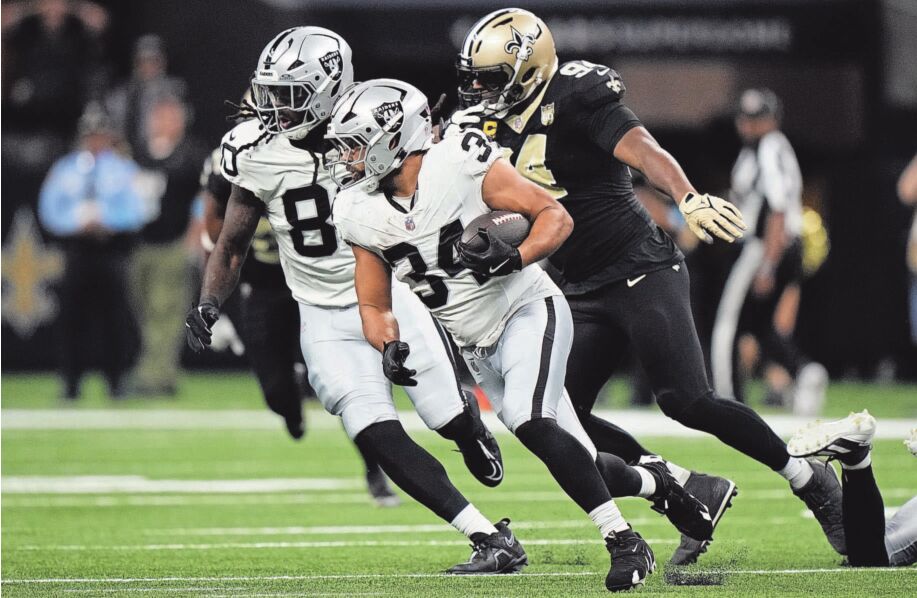
Las Vegas Raiders fullback Connor Heyward carries against the New Orleans Saints in late September. Heyward will line up in the backfield as a receiver and even as a quarterback at times. (GERALD HERBERT / THE ASSOCIATED PRESS FILES)
HENDERSON, Nev. — Connor Heyward spent his first four seasons in Pittsburgh, playing tight end and fullback for the Steelers.
With the chance to go elsewhere as a free agent, Heyward was given an opportunity by first-year Raiders head coach Klint Kubiak to focus on fullback. Heyward knew Las Vegas was his destination.
While fullbacks aren't as common in the NFL these days given the popularity of spread offenses, some teams have committed to using the position and taking an older style of football and updating it with modern philosophies.
That includes Heyward and the Raiders. He often lines up in the backfield, but also plays out of a receiver spot and even as the quarterback in the "Tush Push" when the Raiders need to convert on fourth-and-short.
"It's just fullback doing the dirty work," Heyward said. "I've always prided myself on that, but in Pittsburgh, I wasn't able to showcase this, but here I'm able to play a true fullback position. I did fullback stuff, but was playing tight end."
Heyward said he sees the position making a comeback, but most coaches opt to go without it because of the movement toward passing offences that use three- and four-receiver sets. A fullback is more of a throwback to offences favoured by those who prefer a more traditional approach, though young, innovative head coaches such as Kubiak and San Francisco's Kyle Shanahan often employ that position.
"The fullback position is a key position on our team," Kubiak said. "A guy that can play special teams, all four quarters. He can protect. He can clean up things in the run game. He can fit in at running back if needed. So the fullback has to be a very versatile player. That's what Connor is."
Entering this week, eight teams had used fullbacks 10 or more plays per game. The Raiders had the third-highest rate at 22.6 plays per game, behind the New York Giants (25.2) and Los Angeles Chargers (25), teams coached by the Harbaugh brothers who emphasize a physical style of football.
The average of 14.2 plays per game for fullbacks was the third-lowest since 2006, when it was 50.3. It has been below 20 plays each season since 2015.
Because of the scarcity of fullbacks, teams that use the position could have an edge given opposing defences don't prepare for it much.
The 49ers gained 198 yards and scored two touchdowns when using at least two backs in Monday night's 23-17 win over Washington. They have gained at least 160 yards in multiple-back sets in four of their six games.
"We're in a lot of 11 formations (one running back, one tight end), so people like to go nickel-defence to defend one-back formations," Shanahan said. "But when you have a fullback on the field at any time, there's a threat of I-formation. So defences have to account for that. And there's some things that you do on one-back that aren't very sound versus two-back. So sometimes it could limit the looks we get and things like that."
His fullback, Kyle Juszczyk, gives the 49ers the ability to keep defences off balance because he doesn't line up strictly at that position. But when he does, Juszczyk uses his blocking ability to clear out defenders.
"He's extremely smart — not just because he went to Harvard," Shanahan said. "He can handle anything we give him. When you play fullback at that level, people have to honour what a fullback does compared to a third receiver, which changes personnel.
"Then when it comes to putting him in other spots, it doesn't matter really what it is. He's got as good of hands as anyone I've seen on the team. And he's not scared of the moment. He makes big plays and he is fearless."
Hunter Luepke is used similarly by Dallas, and he doesn't like to define himself as only a fullback.
"I think you have to be an athlete," Luepke said. "You have to be able to block. You have to be able to play special teams."
Cowboys head coach Brian Schottenheimer agreed it wasn't fair to pigeonhole Luepke nor the position itself.
"It's athletes that can do it," Schottenheimer said. "They give you more run-pass flexibility. Former linemen can do it, I mean, 310-pound men that just lean on people. So I do think it's a fascinating position that will never go away. I don't think it ever leaves the game because there's going to be times in every game that you need to run it and make a couple yards, and those guys can be very, very helpful to do it."
Raiders quarterback Kirk Cousins is thankful to have a player like Heyward line up behind him and provide that kind of flexibility. Cousins said he has played with fullbacks since his freshman season at Michigan State in 2008.
"Fullbacks and tight ends, I think tend to be that Swiss Army knife player where if you have one who's as versatile as you want him to be at the position," Cousins said, "he should be able to run a seam route. He should be able to set the edge and block the edge. He should be able to handle protection. The ability to wear a lot of hats gives you a lot of flexibility.
"That's something Connor Heyward can do here, and I think it makes a big difference."
— The Associated Press