
Deer color vision versus human color vision
Deer do not have the visual focus and clarity that humans have, or the same color vision. They do, however, have a much wider peripheral field of view, and they are far better at detecting movement.
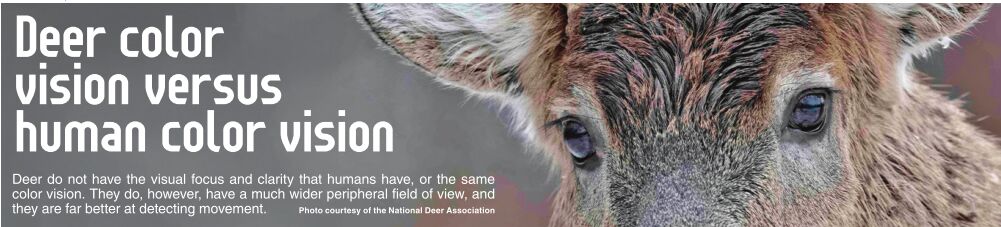
Photo courtesy of the National Deer Association
So don’t wear blue jeans when hunting
Deer hunters have trichromatic color vision. That means our eyes contain three types of cones that allow us to see short (blue), medium (green) and long (red) wavelengths of light.
Collectively, we can literally see millions of colors, unless you’re one of the 13 million Americans who are colorblind. This includes one in 12 men (8%) and one in 200 women (0.5%). According to the U.S. Fish and Wildlife Service, about 80% of deer hunters are male, so that means there are nearly 750,000 colorblind deer hunters (736,000 men and 11,500 women) in the United States.
Enough about deer hunters. How many colorblind deer are there? There are 30 to 35 million whitetails in the United States, and exactly zero of them are colorblind. That said, deer see colors differently than us because they have dichromatic vision. That means their eyes contain two types of cones allowing them to only see short (blue) and medium (green) wavelengths of light. They don’t see reds and oranges like we do, so those colors appear as shades of brown or gray. We know this because the University of Georgia’s Deer (UGA) Lab has been studying deer vision for more than 30 years.
Deer do not have the visual focus and clarity that we have, or the same color vision. However, they have a much wider peripheral field of view, and they are far better at detecting movement.
Deer vision studies
Dr. R. Larry Marchinton mapped deer’s range of vision and sensitivity to light wavelengths in the 1990s. Dr. Karl Miller continued with work studying how deer use their vision to influence movement. Today, Dr. Gino D’Angelo and his students expand our knowledge of deer vision, with projects exploring the visual systems of deer as they relate to their needs.
The UGA Deer Lab has characterized the spectral reflectance of a deer’s retina layer called the tapetum lucidum. They determined the chromatic and achromatic sensitivities of deer under different lighting conditions, investigated movements and resource selection relative to visual perception, and studied photoluminescence with literal glowing rubs and scrapes.
Deer eyes
Deer are a prey species, and their eyes function accordingly. The eyes are positioned on the side of the head and allow a 300-degree field of vision. The only blind spot is a narrow 60-degree space directly behind their head. Deer have 20 times more rods than cones in their retinas, and a tapedum lucidum (mirror) in the back of their eyes that allows them to see 18 times better than us in low-light situations. This is one reason deer are crepuscular – most active at dawn and dusk – and why they can so easily see you climbing out of your stand at dark.
What deer give up in visual sharpness they gain in field of view. A deer has a 300-degree field of view compared to ours at 180 degrees.
Deer also can process visual information four times faster than us and rotate their eyes 50 degrees when lowering their head to keep their elongated pupils level with the horizon. This makes them excellent at detecting movement, even while feeding, and is why they can spot you in a treestand, regardless of whether their head is up or down.
Ultraviolet light
Even though deer and deer hunters see blue, it is not a similar comparison. Humans have an ultraviolet filter in our eyes to protect us from long-term exposure to short (blue) wavelengths of light that can damage our eyes. Deer lifespans are far less than ours, and they’re a prey species, so they don’t have a UV filter. That allows them to capitalize on the additional light from shorter wavelengths, which are most abundant at dawn and dusk, and they see blue nearly 20 times better than us. This is also why hunting clothes should not be washed with detergents containing UV brighteners.
Are deer colorblind?
Deer do not see reds or oranges, so in that regard they’re similar to humans who are red-green colorblind. However, they see blue better than us and also see green and yellow, so they are not colorblind.
Interestingly, many hunters fear wearing fluorescent orange will spook deer, and some of those same hunters head afield wearing blue jeans. In reality, hunter orange clothing helps immensely from a safety standpoint without compromising your location to deer. It’s typically movement, not color, that gives you away. However, those blue jeans are like a beacon announcing your presence, especially in low light situations. This season, keep the orange hat and vest, but leave your blue jeans at home.
Kip Adams of Knoxville, Pa., is a wildlife biologist and the National Deer Association’s chief conservation officer.