
Before the rut: Make the most of bow season’s middle
Stalk, scout and rattle your way to midseason success
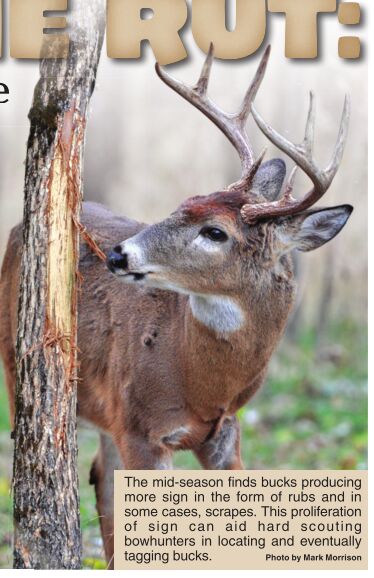
The mid-season finds bucks producing more sign in the form of rubs and in some cases, scrapes. This proliferation of sign can aid hard scouting bowhunters in locating and eventually tagging bucks. Photo by Mark Morrison
It seems like bowhunting season just began, but we are already at midseason if you count the rut as the pinnacle of fall. Whitetail bucks rapidly are shifting from early-season behavior to pre-rut activity, starting rub lines and, in a few cases, establishing early scrapes – a phenomenon often displayed by subordinate bucks whose hormones have them jumping the gun.
On top of that, crops are being harvested rapidly, creating new travel and feeding patterns for deer. Since whitetails are changing their habits, bowhunters must do the same. Scouting this time of year may be even more valuable than earlier outings because information gleaned now can lead directly to punched tags. Some bachelor groups stick together right up to the rut, which means scouting now may reveal several nice bucks traveling together between bedding and feeding areas.
Bucks that have modified their travel routes leave abundant sign in the form of rubs, making it easier to discern patterns and identify promising stand sites. Often, bowhunters can observe these changes from their stands by watching distant deer through binoculars. If a buck follows a new route day after day, a wise bowhunter will slip in and hang a portable stand along it. With abundant antlerless tags available in many parts of the state, keeping an eye on doe patterns can help fill tags and lead to buck encounters as pre-rut activity increases.
One of my favorite midseason antlerless hunting techniques involves lucky timing and some stalking skill. When farmers harvest corn, they often pick the headland rows first, leaving a swath of open ground adjacent to the woods. Deer accustomed to feeding in those areas may continue, but they are no longer hidden by tall cornstalks. They remain comfortable because the standing corn and wooded edge provide security.
The luck comes when rain or high grain moisture causes a farmer to leave the rest of the field unpicked for a week or more. That gives enterprising bowhunters time to stalk feeding deer or hunt the edge from a quickly hung stand.
Personally, I prefer the sneak approach. I filled one of my most recent antlerless tags after spotting a plump, lone doe nosing through corn stubble for kernels. I eased along the tree line, stepping forward only when her head was down.
It took nearly an hour, but I sneaked within 15 yards as she noisily gobbled corn. When cornstalks obscured her head, I slowly drew my recurve and settled into my anchor point, amazed that she had never spotted me. After the release, the broadhead did its work fast, and she fell after only a dozen leaps into the corn. That experience was a satisfying departure from long sits in a stand.
If you have never used a decoy or tried rattling antlers, now is the time. A buck might fail to appear eight times out of 10, but those two successful encounters can be exhilarating. If you are after an antlered deer, decoying can be a great tool. Younger bucks are curious and often more impatient than older, wiser bucks, and they may mimic rut behavior weeks before mature bucks do.
My decoying ritual usually goes like this: I hunt an early morning stand, then quietly hike at midmorning to another stand where I have a decoy stashed. Once I set the decoy and apply scent, I climb into the stand and begin rattling.
Whitetail bucks spare no energy or ferocity when battling during the rut, so rattling can be loud and aggressive then. This time of year, however, it is best to imagine a fight between younger bucks and mimic that noise level. I rattle for five minutes, pause for 20 minutes and repeat that sequence for two to three hours. If I spot a buck, I continue working him until he commits or bolts.
Keep your decoying tools ready for the late season, too. Duping bucks with a decoy and rattling antlers can be even more productive during the so-called second rut.
Finally, bowhunters should renew their practice sessions to make sure their equipment remains properly tuned and their shooting stays sharp. Personally, I love to shoot arrows tipped with Judo points or blunt points at leaves, rotten stumps or dirt clods while hiking through woodlots. Several trips to a local indoor or outdoor archery range can serve the same purpose, building shooting confidence for the moment of truth.