
Into the abyss for late-fall walleyes
Sonar-dodging schools stack up on deep flats and hole rims in late fall
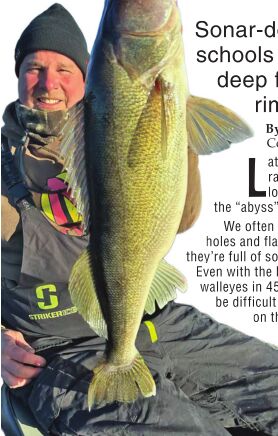
Late fall walleye fishing can range from cranking shallow rocks at night to fishing the “abyss” during the day.
We often overlook the deepest holes and flats in many lakes, and they’re full of sonar-dodging walleyes. Even with the best high-powered sonar, walleyes in 45 to 75 feet of water can be difficult to see. But they’re there, on the mucky bottom.
Connect the deep flats with the deep holes and, “Bam!” Walleye for dinner.
This happens on classic deep, clear walleye lakes, not so much on shallow prairie lakes with maximum depths in the 20-foot range. Productive, deep muddy flats exist in a lot of places throughout a 3,000-acre lake, but I tend to gravitate toward a couple of bulletproof areas.
Let’s start near shore. I try to locate deep mud flats (30 to 45 feet) next to large, weedy shoreline flats with a weed line in the 12- to 20-foot range. Those shoreline flats hold walleyes, pike and bass all summer because that’s where the food is: baby panfish and perch.
On the main-lake side of these muddy flats is the stairway, or slope, to the abyss: a large main-lake hole 50 to 75 feet deep whose edge connects to the deep flat, which in turn connects to the expansive shoreline flat. Some of these are the same flats that produce on your standard midnight crankbait trolling runs. But on a bright, sunny, calm fall day, the flats and holes are easy pickin’s.
Once you’ve located a few areas, you can find the actual schools by slowly driving around and watching down-imaging, side-imaging, a flasher or forward-facing sonar (pointed to the side for more coverage). On some days, keep a close eye out for tiny bumps on the bottom; those are fish. Unless you’re zoomed in, a 17-inch walleye at 40 feet won’t look big or obvious, depending on your sonar settings, boat speed and so on.
The good news is that most of the time these schools are so large, with fish stacked up to 5 feet off the bottom like big schools of bottom-hugging crappies, that they’re easy to see.
Using a zigzag pattern, start at the shoreline basin and work through the flat, aiming slightly toward the rim of the hole. Search the rim, then the hole. These fish move a lot, and in one hour they could use all three areas. On a good day they’ll stay put for 30 minutes, so be prepared to chase a little. That’s why you need to keep your presentation flexible.
I start by fishing fairly fast to find the biggest concentrations of fish and verify what I’m seeing on the screen. My first choice is a 2-ounce bottom bouncer dragging a 3- to 4-foot leader and a No. 2 hook tipped with a minnow or half a crawler. Troll at 0.5 to 0.8 mph and vary the speed until three fish prove the secret speed. One fish is a fluke, two might not be a fluke, and three is proof. After a while, you’ll figure out whether the schools are moving or sitting.
If they’re sitting, the classic ¼- to ⅜-ounce jig-and-minnow combo will work with spot lock on, or however you like to hover over the fish. Just don’t use an actual anchor. Bad idea.
A couple of other options: a live-bait rig with a ¾-ounce sinker and a lively minnow will do the trick, and so will a No. 7 to No. 9 Jiggin’ Rap pounding the bottom. White, of course, will work. Don’t have a Jiggin’ Rap?
Try a jigging spoon with a minnow head, just like ice fishing. A forgotten killer for suspended fish is a drop-shot rig. Yes, the drop line could be 5 feet long, but who cares? At that depth the fish aren’t picky. Use what you want.
One final word of caution: Be prepared to keep every fish you catch from these depths, because barotrauma often kills them. Not sure whether a fish will make it? Hold it hostage in the live well for 15 to 20 minutes. If it seems happy after that, odds are it’s good to go back down. Just make sure your hostage fish doesn’t put the boat over the limit!
Read more from Capt. Josh Hagemeister of Minnesota Fishing Guide Service at www.minnesotaguideservice.com.