
Houthi missiles strike Yemen government HQ
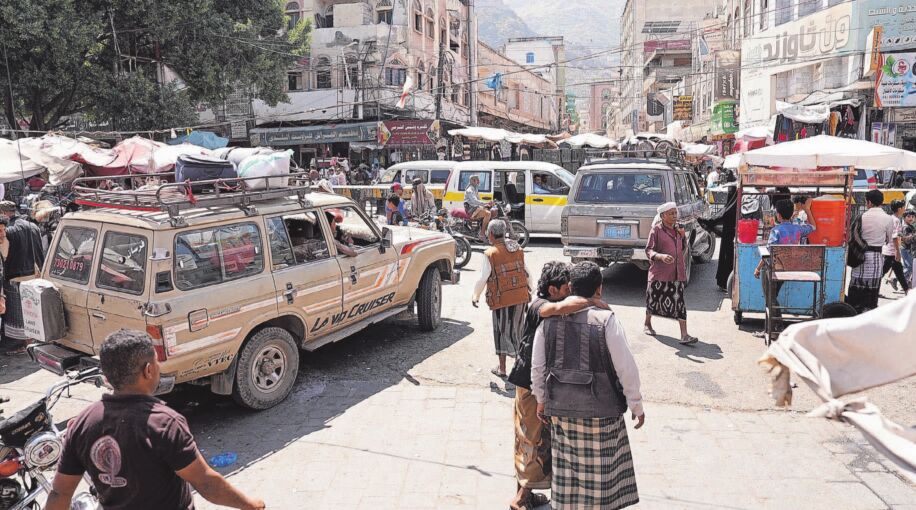
People crowd a minibus station used by those displaced to leave the city, in Taiz, Yemen, Thursday. Residents are running low on basic goods, fuel stations sit empty and aid is scarce. MARZOOQ AL JABRI / THE ASSOCIATED PRESS
DUBAI, United Arab Emirates — The Houthi militia struck the headquarters of Yemen’s government with a missile barrage on Thursday, killing five people, officials said, as casualties mounted across several fronts of fierce fighting.
Additionally, at least 16 people were injured in the Houthi attack on the Maashiq palace in Aden, the southern Yemeni city that serves as the seat of the country’s internationally recognized government, health officials said.
Shayea al-Zandani, the prime minister, was not hurt, according to the Yemeni information minister, Moammar al-Eryani. It was unclear whether al-Zandani was present at the time of the attack.
While the extent of damage to the palace was unknown, videos shared on social media Thursday show smoke rising from near the building and visible over a mile away.
Aden has been the seat of Yemen’s government since 2015, after the Houthis seized the capital city, Sanaa, igniting a decade-long war. While nominally the official authority in southern Yemen, the government has limited powers there because in practice it has for years operated largely from exile in Riyadh, Saudi Arabia.
Shortly after the strike on the palace, the Saudi-backed government in Yemen said Houthi fighters had also launched several ballistic missiles at Marib, an oil-rich city in central Yemen.
Yahya Saree, a military spokesperson for the Houthi militia, said the group targeted the “Saudi enemy’s military operations in Aden,” but he did not immediately mention any attacks on Marib.
The International Committee of the Red Cross said that the cities of Marib and Taiz, along with areas along the Red Sea coast, are now suffering some of the worst casualties of the war, with several hospitals receiving more than 700 admissions in a single week.
The attacks Thursday came as fighting has intensified in recent days, with repeated strikes in both Yemen and Saudi Arabia.
Saudi warplanes have supported government forces trying to recapture strategic Houthi-held territory along the Red Sea, where fierce ground battles have raged for days. Houthi attacks, meanwhile, have increasingly targeted Saudi Arabia, striking energy facilities and airports.
Saudi Arabia on Thursday accused Iran of fuelling the latest turmoil and said that the Houthis had rebuffed attempts at diplomacy.
Maj. Gen. Turki al-Maliki, the spokesperson for the Saudi-led military coalition in Yemen, said at a news conference Thursday that the Houthis had fired more than 1,000 ballistic missiles and more than 1,100 drones at Saudi Arabia since July, killing 19 people and wounding almost 400 others. It was the first cumulative death toll announced by the Saudi-led coalition since hostilities reignited.
Al-Maliki said the Houthis had become the first militia of its kind to obtain ballistic missiles, explosive drones and bomb-laden boats. He alleged that the Houthis had acquired the weapons “with the assistance of regional parties,” a phrase Saudi officials routinely use to refer to Iran.
When asked for comment, the Iranian Embassy in London said officials from the Ministry of Foreign Affairs would respond, but the ministry did not immediately do so.
Rayed Krimly, a Saudi foreign ministry official, told reporters that Iran had “continued to arm, train and support the Houthis,” encouraging their attacks in Yemen.
Krimly also said Saudi Arabia had recently asked the Houthis to meet for talks in Muscat, Oman, but the group had refused.
Dhaifullah al-Shami, a Houthi political figure, rejected that account but said that it was incumbent on Saudi Arabia to end its isolation of Houthi-controlled parts of Yemen and de-escalate, saying, “It should end its blockade of and aggression against the Yemeni people.”
The Houthis frequently accuse Saudi Arabia of attacking infrastructure in Yemen and say their own attacks are retaliatory. Last week, news media affiliated with the group accused Saudi Arabia of bombing an airport in Sanaa. On Tuesday, Saudi strikes on an oil facility in Hodeida, a port controlled by the militia, killed at least two people, according to a spokesperson for the Houthi-run Health Ministry.
The fighting has worsened a dire humanitarian crisis in Yemen. In the besieged city of Taiz, Yemen’s third-largest, residents are running low on basic goods, fuel stations sit empty, and the World Food Program said it can no longer reach more than 600,000 people who depend on food aid.
Fighting resumed in Yemen this year when a fragile truce, agreed to in 2022, unravelled. The tensions erupted after the United States and Israel attacked Iran, touching off a wider regional war.
— The New York Times