
AI robots roaming grocery store aisles; shoppers, workers are worried
ELLA CHAKARIAN
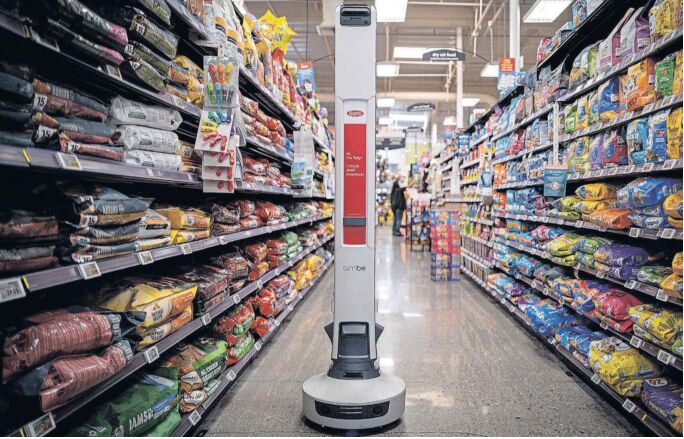
The autonomous, AI-powered inventory robot monitors shelves in a Ralphs supermarket in Los Angeles.
ELLA CHAKARIAN
LOS ANGELES — The robot takeover looks a lot different from what we see in Hollywood thrillers.
Even an artificial intelligence-powered humanoid with running speed, the physical bobs showing up in our daily lives are more mundane and real.
On Wednesday morning at a Ralphs grocery store in Los Angeles, a skinny, six-foot-tall robot named Marty was rolling down the aisles, beeping noises, its lights flickering purple and green. A small screen on the top of the tower had two blinking eyes and a message: “I’m here to help.”
“Robot Robot,” a young boy yelled.
Some adults looked confused, others laughed. Ricardo Valadez, a 62-year-old real estate agent, said he felt like the robot was stalking him around the store. He didn’t know if it was just checking the shelves or what this missing out of place.
“I was kind of like, ‘What the hell is that? I don’t know why I felt that it was following me.’”
With a recent rollout at some L.A.-area stores, including those owned by Ralphs’ parent company, Kroger, Simbe Robotics joins the other free-form forms of physical AI that are already operating in grocery stores, such as food-delivery bots and Waymo’s self-driving cars.
From inventory management to marketing and checkout, retailers are jumping on the AI bandwagon. The global retail automation market could jump to $57 billion by 2034 from $28 billion in 2023, according to research company Precedence Research. For Business Insights.
Simbe says more than 3,000 of its bots have scanned over 20 billion shelf items worldwide. Kroger, the parent company of Ralphs, is using hundreds of them after pilot projects that started during the pandemic in California and Arizona.
Simbe provides shelf intelligence for retailers, which can help them easily identify and address products that are low or out of stock, giving associates better information to support customers, said Jeff Harnar, a spokesperson for Simbe Robotics in an email.
She says Tally helps employees decide where their time is best spent. In January, the company revealed its latest model of the robot, Tally 40, which can scan shelves faster and is aware of speeds up scanning shelves to create insights.
Tally alerts employees to any misplacements or items that don’t belong in the aisle, not identify or track humans.
In a recent release, Simbe said its bots do more than count; they help improve product placement and pricing for products.
“Every deployment expands Simbe’s understanding of how conditions on the ground impact core retail value chains — from inventory availability and product location to pricing, promotion and merchandising,” the release said.
Other retailers in Los Angeles have also introduced Tally to their aisles, including Stater Bros., which operates nearly 170 stores across Southern California. Tally has also been spotted at retailers across the United States, including Kruger, Lowe’s, Tesco and BJ’s.
The robots use a combination of computer technology to gain real-time insights on product inventory,” a Ralphs spokesperson said. “Our associates can more easily and quickly identify and address shelves where products are low or out of stock.”
But how many Tally bots have information about how many Tally bots have been deployed? A LinkedIn post from a store manager, Kruger-scrubbed from the internet, showed that Kruger deployed its 500th robot across all of the Kroger chain in August.
Jonathan Marino, chief commercial officer of Simbe, said the company was “investing aggressively” in artificial intelligence and that it has helped save money.
Rachel Fournier, an employee at Ralphs in Los Angeles, said the Tally bot just showed up one day, but employees were told it would monitor shelves and keep track of inventory. With self-checkout and digital shelf tags already reducing the need for employees, some workers worry about their jobs.
“Even an inventory job, like now, that’s being shipped out to a computer,” Fournier said. “What are they trying to do here?”
There needs to be more discussion ahead of time and sign-off from employees about these changes being deployed, said a local union.
“Our members should not be finding out about major changes to their workplace only after new technology shows up,” said Kathy Finn, who represents workers who staff the shelves, identifying out-of-stock products and maintaining store conditions are all areas where our members add value,” she said.
While it’s not the kind of employee that would be doing inventory, Kroger could use up to three years as it ramps up its use of artificial intelligence to streamline operations.
Some unions have been pushing back on earlier automation efforts at stores. In Northern California, the United Food and Commercial Workers Union Local 770, which represents workers at Kroger, outlined concerns about deploying Tally in a statement last year, saying the technology erodes member-concerned Fred Mayer locations.
“Union members regularly do this work,” the statement said. “We believe that taking good-paying jobs away from our members will erode our unity in the workplace, reduce available hours for those who need them most and threaten the stability of our benefits.”
Ralphs employer Fournier said she and others worry about job automation replacing human labor. She said she needs to monitor shelves with self-checkout and digital tags already reducing the need for employees, some workers worry about their jobs.
— Los Angeles Times