
‘A generational impact from playground to podium’
Additional federal sports funding to ease financial burdens, invest in athletes
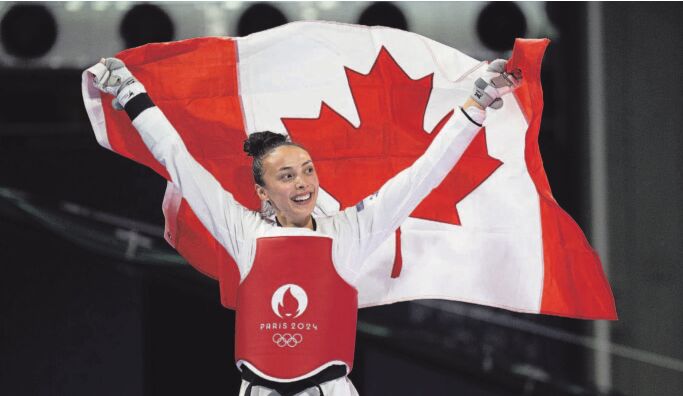
Skylar Park says being an Olympic athlete is not as glamorous as people might assume. ADRIAN WYLD / THE CANADIAN PRESS FILES
SKYLAR Park hearkens back to the same story anytime she reflects on the support she’s received throughout her career.
It’s one she can’t help but grow emotional about.
It was 2017 when Winnipeg’s prized taekwondo athlete made the World Taekwondo Grand Prix for the first time. The international event, held in Moscow, featured the top 32 athletes in the world. Park was the lone Canadian.
In many ways, she felt the weight of the country on her shoulders.
“It was very daunting. It was just me and my dad walking into the stadium, and it felt like it was my dad and I against the world,” Park said as tears rolled down her face inside Canadian Sport Centre Manitoba on Thursday.
“I think I get emotional now because there are so many people in this room who’ve been a part of my journey since that day.”
The story was apt for the now-Olympic bronze medallist to tell on a day when she felt that wave of support from the highest level of government.
On Thursday, Sport Canada announced an additional $5.4 million in federal funding for the seven branches of the Canadian Olympic and Paralympic Sport Institute Network (COPSIN).
The financial backing is in addition to the government’s $11.9 million in core funding across each network, $324,843 of which was allocated to the Canadian Sport Centre Manitoba (CSCM). After Thursday’s announcement, CSCM’s total Sport Support Program funding will total $537,175 for 2026-27, an increase of $212,332.
“I think as athletes, the journey is so lonely,” Park said. “It’s late nights, it’s early mornings, it’s the battle in your head (of) how you’re going to do it, how you’re gonna make it happen. We all have these big goals and these big dreams, and it’s hard, and it’s lonely.
“I’m grateful to have my family along with me on that journey. But it is still an individual sport at the end of the day, and a lot of us Olympic athletes, we are in individual sports, and so to know that you have a community, the government, a country behind you, and recognizing you and supporting you truly means the world.”
The funding will be used differently by each COPSIN.
In Manitoba, support will act in a similar fashion to the existing Athlete Assistance Program, which gives athletes a carding cheque to help with services like coaching, nutrition, physiotherapy, mental performance, medicine, physiology and monthly rent.
Secretary of State for Sport Adam van Koeverden announced the financial backing alongside a small cohort of past, current and future Manitoban Olympic and Paralympic athletes.
“Important to note that we’re not making these investments so that every kid who learns to run or jump or throw a ball or swim or ski or skate becomes the next Cindy Klassen or Clara Hughes,” van Koeverden said.
“Whether they want to be competitive or not, investments of this nature are really good for our economy. They’re great for our healthcare system. They take burdens off of mental health supports because they are naturally mental health supporting. And other countries have demonstrated that when you invest in sport, that builds up your community.”
The announcement comes after a momentous summer for high-level sport in the country.
In July, following the FIFA World Cup, Prime Minister Mark Carney announced a $1 billion investment in sports infrastructure, the largest federal investment for Canadian sport.
From that $1 billion, $250 million is dedicated to improving facilities across the country, while another $755 million is allocated to National Sport Organizations.
Through that $755 million, Sport Canada announced in July it would increase its AAP program funding by $3 million annually for a total of $43 million going to its athletes over several years. Athletes across the country are now receiving $2,300 tax-free monthly.
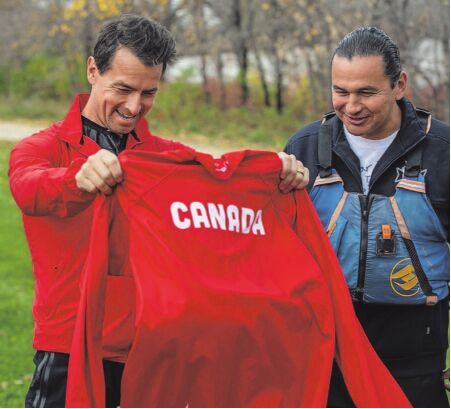
Adam van Koeverden (left), Secretary of State for Sport, gives a Team Canada jacket to Manitoba Premier Wab Kinew after an Olympic funding announcement in Winnipeg on Thursday. BROOK JONES / FREE PRESS
The most recent announcement comes after Sport Canada assessed the Future of Sport in Canada Commission report and determined that NSOs across the country were hanging on by a thread, and more funding would be needed for athletes to succeed.
"It's truly for the entire ecosystem," van Koeverden. "It's a big number because it's a big sector and it's an important investment. It's the biggest in our country's history, and it's going to have a generational impact from playground to podium for years to come."
Winnipeg-born skeleton athlete Sébastien Régnier spends anywhere from $30,000 to $35,000 per year on his sport.
Régnier said reaching out to prospective sponsors can be a distraction, especially in the off-season when he'd rather be dedicating his energy to gearing up for the season.
"You have to allot a certain amount of time to draft a budget, draft some emails, packages, whatever for sponsors, and try to kind of put yourself out there and ask for money essentially," Régnier, who now lives in Whistler, B.C., said.
"It definitely is a bit of a mental burden to gather up all those funds. I've been very fortunate that I've been able to make that up every season, but I still have to make sure my relationship with sponsors and donors is good and to continue them to make sure I can continue getting money for the next season."
Park shared a similar experience about her younger brothers, Tae-Ku and Braven, who often pay out-of-pocket to attend taekwondo events around the world in hopes of climbing the international rankings and one day representing Canada on the biggest stage.
"As a younger athlete, I assumed that athletes kind of had everything covered, and we're living a glamorous life," Park said. "I'm very grateful for the life that I live, but it's not always as glamorous as it looks."
The hope is that the extra cash can ease the burden, even if it's marginal.
"That's a world-class investment in world-class athletes. It's a living and training allowance that makes a huge difference for our athletes, and provinces do their part with our national teams and our next-gen athletes, as well," said van Koeverden, adding that Sport Canada is also looking into how institutions like CSCM can provide meals for athletes and food cards for grocery stores.
"So in provinces like Manitoba, athletes can expect that support that they deserve when they're representing us."