
Crash
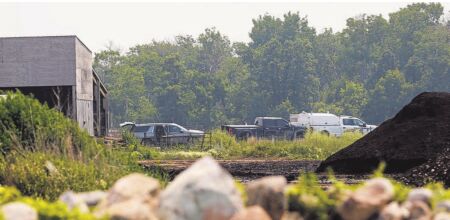
Investigators at the scene where two planes from Harv’s Air flight school crashed south of Steinbach in July 2025. (Mike Deal / Free Press files)
There was no further communication between the pilots, Vermette said.
Less than 20 seconds later, the Cessna 172R was about 30 metres (100 feet) directly above the Cessna 152. After the planes made brief contact, the Cessna 152 pilot immediately applied full power, and the aircraft pitched up, the TSB said.
The planes collided again, became entangled and crashed about 400 metres south of the runway in the Rural Municipality of Hanover. Both were destroyed by flames.
The report did not name the pilots. It said the Cessna 172R pilot had a private licence since August 2024 and 169.4 total flight time hours, including 73.2 solo hours. The Cessna 152 pilot had a student permit since April 2025 and 59.3 flight time hours, including 14.4 solo hours.
About six months earlier, two Harv’s airplanes were at risk of colliding while approaching runway 18 at the airport, the TSB said. Both landed safely.
The company then required all radio calls on final approach to include the distance from the runway to improve situational awareness and help pilots to spot other planes.
Neither pilot who died in last year’s crash stated their distance from the runway on any of their radio calls that day, the TSB said.
Visibility distance was greater than the length of the circuit, despite wind-blown smoke from northern wildfires, and meteorological conditions were suitable, the TSB said.
The circuit’s base leg, where the Cessna 152 pilot made the turn to begin their final approach, pointed almost directly into the sun. It was not determined if one or both pilots had sunglasses on, the TSB said.
Neither plane was equipped with a collision avoidance system, nor did federal regulations require them to be.
It could not be confirmed whether one or both planes had any lights turned on, other than beacon lights, despite it neither being legally required nor school policy for daylight flights at that time.
Harv’s Air has since taken steps to reduce the risk of a mid-air collision in the circuit, the report said. The school now limits the number of planes in a circuit to three.
The company installed LED lights on its planes, which must be on at all times during flight, and equipped more aircraft with technology that automatically broadcasts information, including a plane’s position.
Harv’s Air students and aircraft renters must attend safety briefings related to effective lookout techniques and situational and aircraft blind-spot awareness. Company president Adam Penner could not be reached for comment.
The TSB investigation was intended to produce safety messages to prevent similar incidents. The agency doesn’t assign fault or blame.
The report’s safety message said the crash highlighted the limitations of the “see-and-avoid” principle (a basic method pilots use for visual surveillance and collision avoidance), and why it’s important for pilots to actively listen to radio calls from other planes to maintain situational awareness.
Investigators could not determine whether the pilots were or were not actively listening to radio call.
Previous investigators found, given the principle’s limitations, there is a greater risk of collision in uncontrolled airspace when relying solely on visual detection.
An aircraft on a collision course will usually appear to be a stationary object in the pilot’s visual field due to the geometry of collision flight paths, the report said.
The safety message also encouraged plane owners and pilots to install systems that provide air traffic information to enhance pilots’ situational awareness.
Planes belonging to Harv’s Air have been involved in two other incidents since January 2025, when an instructor was hit by a propeller.
Two pilots from India died when a Cessna 172, which was rented, crashed near Kisbey, Sask., on Sept. 18. The crash is under investigation.