
Hot take on Canada’s Rainy Lake
Finding fun, fish and fragments of the past ‘in the middle of nowhere’
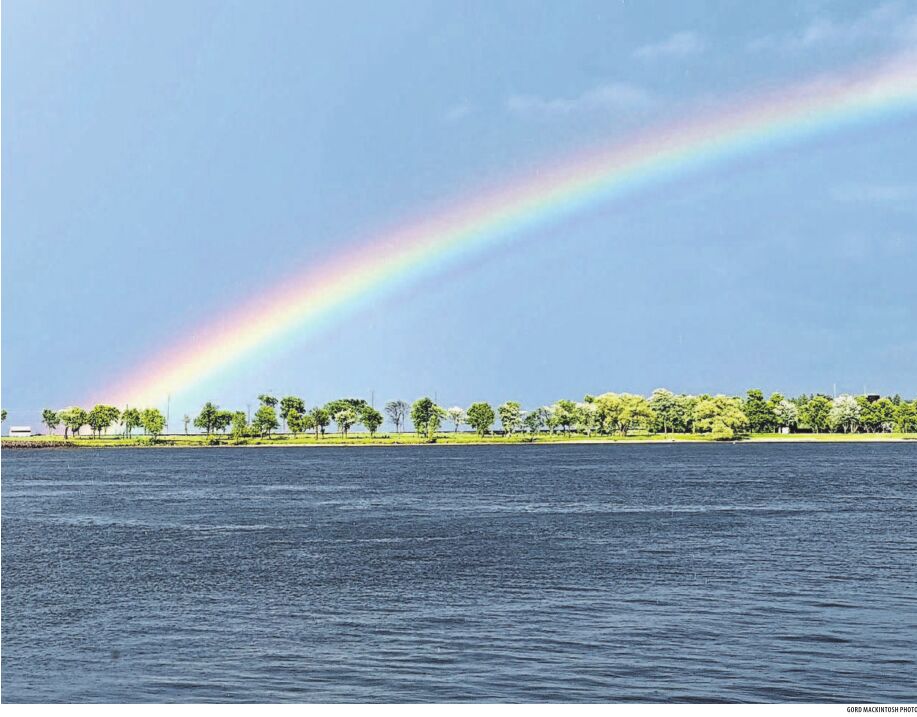
A colourful view toward Seven Oaks, Ont. GORD MACKINTOSH PHOTO
BOASTING more than 2,000 islands, fish-filled Rainy Lake sits about 70 per cent in Ontario, the rest in Minnesota. Fish can’t discern the international line. Neither can fishers, unlike the U.S. Border Patrol — as if I’d know much about that.
Well, not much.
Four or five hours from Winnipeg, Rainy Lake stretches east from Margie’s and my cherished hometown of Fort Frances — “The Fort.” Discover LaVerendrye Parkway, Betty’s, Northwoods Gallery, the Flint House, Hallet Brewing. And arriving through Emo, find the wonderfully eclectic Emo Feeds store offering “Rainy River District” fridge magnets showing a hayfield against the Rockies.
The Fort abuts the U.S. boundary. The town’s recent tagline: “Boundless.” And it is, right up to the boundary. Across the Rainy River lies the city of International Falls, Minn. — “The Falls.” If a resident says, “I live in The Falls,” you exclaim, “You must get soaked!”
Canadian waterfront lodging means La Place Rendezvous, or “The Vous.” Book early for second-floor lakeside rooms. Enjoy creative meals on the deck overlooking big Sand Bay. It’s a Vous view. Say that three times.
Where Rainy Lake flows into Rainy River, the modest Bayview Motel also offers some water views. Jaunt to a riverside picnic table or to The Harbourage, a favourite eatery. Behold morning’s din as itinerant fishers gather. One exclaimed among roaring men, “That big fish fought so eff’n bad, I had to shoot it!” Our server whispered to Margie, “And they say women talk?”
Stroll to a nearby destination called Seven Oaks. I suggest they call it “Six Oaks.” Park at gentle rapids flowing during low water under the international rail bridge. Up Highway 11, on Couchiching First Nation at Took-Titch Road, Gen7 Fuel offers the cheapest gas and more. Further, find The Great Bear store. A life-size plush bear keeps watch with the right to “bear” arms.
Speaking of arms, Rainy Lake features a South Arm, a North Arm, plus Finger Point. For more anatomy, there’s Knuckle Island and a bay endearingly called Red Gut. There’s Bears Pass — as if bears graduate, and the Five-Mile Dock — as if it’s five miles long (it’s five miles from The Fort’s downtown).
The most astounding sections of the Noden Causeway do stretch well over a mile. Officials opening the Causeway in 1965 announced “the world’s longest pre-stressed concrete bridge.” That’s because when drivers see its height, they’re pre-stressed.
Several well-kept Canadian fishing resorts thrive with boat rentals, usually for guests. So, for day-trippers to access what locals call “up the lake,” it’s largely BYOB — bring your own boat. Highlights include idyllic Sandpoint Island Provincial Park. Near a rock outcrop that supports a puzzling concrete pedestal called “The Urn,” find Rainy’s sweetheart — a picturesque, 94-year-old cement mermaid.
This summer, our pal Zukes took us to find Pukamo Island’s ancient Indigenous pictographs. Wow — the wind that day! The boat whacked whitecaps so jouncy, I kept checking for my cellphone, keys, my teeth. And for Margie.
We boated around Pukamo Island three times without success. Disheartened, we then found one online map that oddly located the pictographs on a different island, albeit partly in a Pukamo Island bay. As we circled that for a second time, an eagle swooped around a southside shore. Margie assured us, “The eagle’s showing us the way!” And, yikes, we eyed the precious red ochre drawings. They include an upside-down human, maybe a curved canoe being portaged and a large-mouthed creature. Mystery!
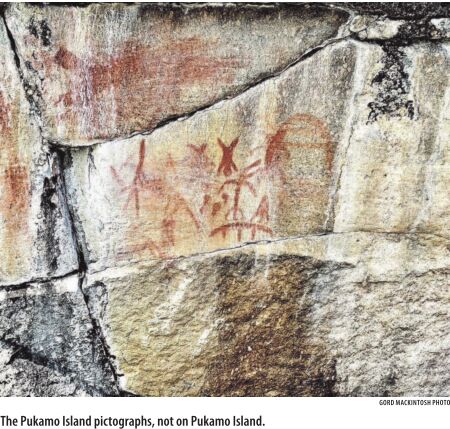
The Pukamo Island pictographs, not on Pukamo Island. GORD MACKINTOSH PHOTO
Despite its accessible, mid-continent world-class fishery, clear waters and beaches, Rainy Lake features notoriously light boat traffic. Seeing two boats pass, Zukes exclaimed, “Rush hour!”
We witnessed more float planes than boats at Margie’s parents’ cabin (there are no “cottages” here). The official travel guide teases “FIND YOURSELF. In the middle of nowhere.” Rainy even has a Nowhere Island. Illinois-based MidWest Outdoors magazine reports, “Ontario’s Rainy Lake remains a best kept secret.” MPR News calls it “a pristine, hidden paradise.”
Savour local walleye. (Influenced more by American fishers than Manitobans, there are no “pickerel” here.) Americans tend to travel further north, believing the size and sum of fish are determined by latitude. And maybe the name “Rainy Lake” deters fishers. Thankfully, others believe the fish bite when it’s rainy.
The Fort and The Falls host bass championships. These became hugely successful thanks to devoted volunteers, and once the electric bass players figured it out.
Overheard by our pal Jim at Rainy Lake Sports and Tackle: “How much for a dozen minnows?”
“About ten bucks.”
“How much for dead ones?”
“They’d be free.”
“Then, how ’bout killin’ me up a dozen a’ those?”
Nephew Andrew took the family fishing in the North Arm. Andrew swiftly caught four walleyes and others caught two or three each. My line hung limp.
Two hours later, Andrew said, “Change sides, Uncle Gord!”
I said, “Good idea!”
My line hung limp.
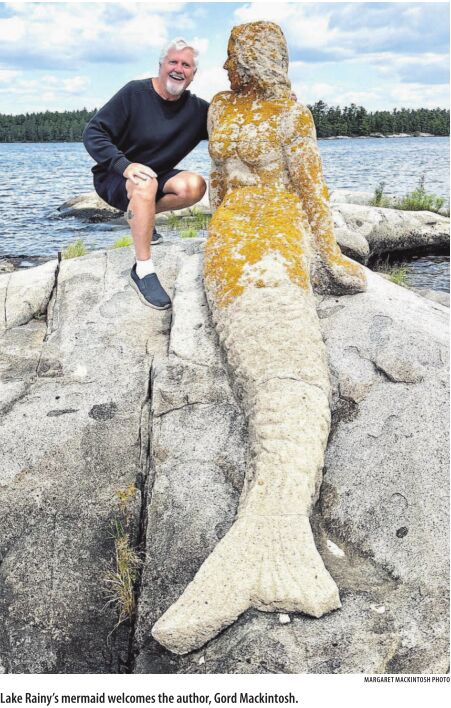
Lake Rainy's mermaid welcomes the author, Gord Mackintosh. MARGARET MACKINTOSH PHOTO
Andrew consulted his fish finder and exclaimed, “Three big fish are right below you!”
My line hung limp.
Daughter Dorothy asked, “Why are you so bent over?”
I explained, “I’m an angler.”
Andrew then suggested, “Let’s trade rods.”
That made sense. He swiftly caught a big bass. I took a photo — because it was my rod, my fish.
Suddenly my rod bent wildly. I shrieked and reeled in a nice one.
In Black Sturgeon Bay, my father-in-law Otto and I caught a fish at the same time. He yelled for the net. I yelled for the net. Otto caught its mouth. I snagged its tail. Otto shouted, “A walleye!” I shouted, “A pickerel!”
Both times, it wasn’t rainy. Indeed, some folks believe fish avoid getting wet.