
Witkoff calls Putin a ‘humanitarian’, thanks him for releasing American
Release of 74-year-old teacher follows direct appeal by Trump to Russian leader
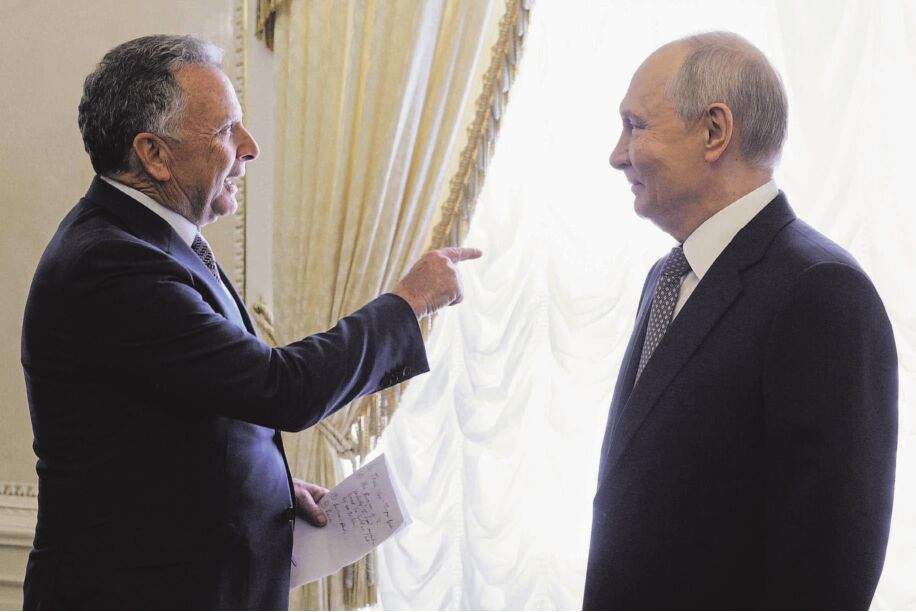
Special envoy Steve Witkoff (left) gestures during his meeting with Russian President Vladimir Putin at the Konstantin Palace in Strelnya, outside St. Petersburg, Russia, on Wednesday. (GAVRIIL GRIGOROV / SPUTNIK, KREMLIN POOL)
WASHINGTON — Praising President Vladimir Putin as a “humanitarian,” President Donald Trump’s special envoy, Steve Witkoff, thanked the Russian leader in St. Petersburg, Russia, on Wednesday for releasing an American held for more than four years on what the State Department called fabricated charges.
The release came after Trump made a direct appeal last week to Putin to let the 74-year-old teacher, Stephen James Hubbard, return to the United States. Russia had accused Hubbard, who was held for more than four years, of being a Ukrainian mercenary and sentenced him to more than six years in a penal colony. Hubbard had been seized by Russian troops in Ukraine, where he was living, but there was no evidence he was involved in the battle after Russia’s invasion.
“You talk so much about my president, President Trump, being a humanitarian,” Witkoff told Putin, whom he was meeting to discuss another variant of plans to end the war. “You are a humanitarian also, sir, and I salute that.”
The phrase hung in the air because Putin, who started a war of aggression against Ukraine that has led to the deaths of tens of thousands of Ukrainian soldiers and civilians, is wanted as a war criminal by the International Criminal Court. Putin, who has repeatedly expressed sympathies for strongmen and parroted Kremlin talking points, has long made clear his admiration for the Russian leader and earlier this month imposed sweeping sanctions on the ICC, seeking to cripple its work.
His envoy’s public embrace of Putin on Wednesday capped a tumultuous 12 days in which Trump has repeatedly sided with Russia and sidelined Ukraine.
Trump has announced that the United States will buy Russian diesel fuel and suspend the imposition of new sanctions under a bipartisan law he signed recently. Trump has also called on Ukraine to replace President Volodymyr Zelenskyy, Putin’s nemesis.
Ukraine said the United States had intermittently cut off intelligence sharing; limited its access to Starshield, the military version of the satellite internet service Starlink; and suspended delivery of its already limited supply of Patriot interceptors, the only defence Ukraine has against Russian ballistic missiles.
Witkoff, over repeated visits to Moscow, has been accused by his critics of what they term overly solicitous behaviour toward Putin. Trump himself faced similar criticism for welcoming Putin to Alaska with a red carpet in the summer of 2025, ending years of diplomatic isolation for the Russian leader over the full-scale invasion of Ukraine.
The Trump administration responds that it is doing what it needs to do in an effort to rebuild a relationship with the Russian leader as it pursues negotiations to end the war.
Trump’s posture toward Russia is out of step with most Americans. The vast majority of them — 79% — have an unfavourable view toward Russia, according to polling from Gallup, a number that has been on the rise during the past 15 years.
On Wednesday, Trump wrote on social media that he had asked Putin last week to release Hubbard, and said the longtime prisoner, the last American on the State Department’s list of “wrongfully detained” U.S. citizens in Russia, was “on his way back home and will soon be with his family.”
Joseph Coleman, one of Hubbard’s sons, talked to his father on the phone shortly after the United States gained custody, said his lawyer, Martin De Luca, who was also on the call, along with Witkoff and Jared Kushner, Trump’s son-in-law. De Luca said Hubbard sounded fragile, but he didn’t speak much: “He said how excited he was to see his kids and how excited he was that his kids would be waiting for him.” Hubbard’s two sons, who live in Cyprus and Japan, flew to the United States to meet their father. The plane will stop in Washington and then travel to a U.S. State Department facility in Texas, where doctors will assess Hubbard’s health. Hubbard could visit the White House as early as next week, depending on the assessment, De Luca said.
“The United States, out of respect for President Trump, was not required to give anything in return — an unprecedented situation for Russia,” Trump wrote in his Wednesday post. “There was no ‘swap’ necessary for this release.” While unilateral releases are not unprecedented, they are rare, and Witkoff deflected early efforts by the Russians to release Hubbard only in a swap. He appears to have convinced Putin that the goodwill gesture would be helpful at a turning point in the relationship between Washington and Moscow.
Turning over Hubbard, who was tortured, sometimes starved and placed in the general prison population in a country where he did not speak the language, came at little cost to Putin. But the move buys him goodwill with Trump, who is arguing that he alone has the relationship with Putin needed to get him to end the war.
Witkoff’s remarks came at the start of talks in St. Petersburg, where the U.S. envoy had come to discuss new variants of a proposed plan to end the war that began with Russia’s invasion of Ukraine in February 2022.
He told Putin he had “brought some papers” with “some ideas about the different elements of some sort of peace deal,” saying that the Russian leader could “read that at your leisure later.” The men met for approximately three hours.
Trump had telegraphed that he had sought Hubbard’s release, talking to reporters about it Tuesday, when the former teacher was still in captivity. But Trump didn’t mention that Hubbard was being held because Putin’s government had sought to take American prisoners for leverage.
As Putin and Witkoff were meeting, though, Russia’s security services announced the arrest of a German citizen on charges similar to Hubbard’s.
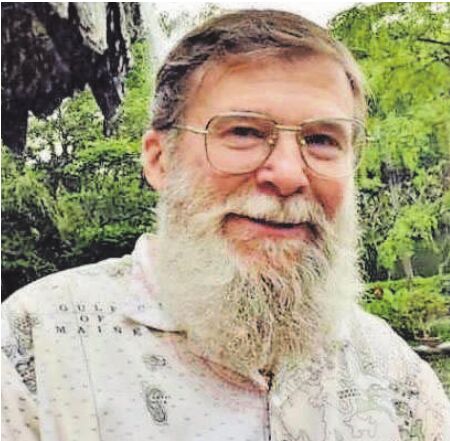
Stephen James Hubbard, 74, was held in Russia for more than four years. (PATRICIA HUBBARD FOR VIA THE NEW YORK TIMES)
In recent days, as Hubbard was moved out of a penal colony and prepared for release, it became clear that his value to Putin had changed. He was now more valuable to the Russian leader as a symbol of the renewed relationship with the U.S. president than as a pawn in negotiations.
Hubbard was essentially abducted by Russian soldiers from eastern Ukraine shortly after Russia invaded and accused of fighting for Ukraine. Russian sentencing documents said he was given the call signs, or nicknames, of “Samurai” and “Ninja,” and that he manned a checkpoint on a bridge over a river.
This was highly unlikely.
Hubbard, a Michigan native, was living in the city of Izium, near Kharkiv, after a peripatetic life, teaching English for years in Japan and moving for a time to Cyprus, where one of his sons lived, before settling down with a Ukrainian woman. After that relationship ended, Hubbard opted to stay in Ukraine.
He had just turned 70 when the Russians invaded. His son in Japan told him to keep his head down, but Hubbard did not seem to understand that the war had started, text messages between the two men showed. Those messages also showed no evidence that Hubbard had joined the Ukrainian military. He told his son that all was well. He gave daily updates, like when he went to church. He had a hard time buying food, but said once that he bought caviar “for nutrition.”
The Russians said they arrested him inside the home of an acquaintance in April 2022.
Ukrainian prisoners of war who were held with Hubbard later told The New York Times that he had been repeatedly tortured because he was an American — beaten, forced to stand all day, given little food and poor medical care. In interviews after they were released, the Ukrainians said they feared for Hubbard’s life.
In October 2024, a Russian court convicted Hubbard of being a mercenary and sentenced him to almost seven years in a penal colony.
Unlike other Americans held in the Russian prison system, Hubbard was kept in the general population, his lawyers said. At times, his family had no idea where he was, and the U.S. Embassy had no access to him.
Hubbard was designated by the State Department as wrongfully detained in January 2025.
Shortly afterward, De Luca, a former federal prosecutor instrumental in winning the release in February 2025 of another American held by Russia, started working on Hubbard’s case.
EPAM Law, a Moscow law firm that worked with De Luca on that earlier release, found out that Hubbard was being held in the IK-12 penal colony in Mordovia, the southwestern Russian region commonly referred to as “prison land.” In May 2025, Hubbard was allowed to call Coleman, his son in Cyprus.
Coleman, who is a Greek Orthodox priest, wrote a long letter to Putin in September, making a point of his Orthodox faith, similar to Russian Orthodox, and pleading for his father’s release.
On Tuesday night, Coleman said he was looking forward to seeing his father and that he would do whatever he could to help him upon his release.
“I don’t want to be stressful to him,” Coleman said. “I want to be in his presence and make sure he’s healthy and he’s well and, you know, if he wants to talk, we’ll talk.”
— The New York Times