
MEGA MILES WITHOUT LEAVING HOME
In backyard ultramarathon boom, race goes on until everyone gives up
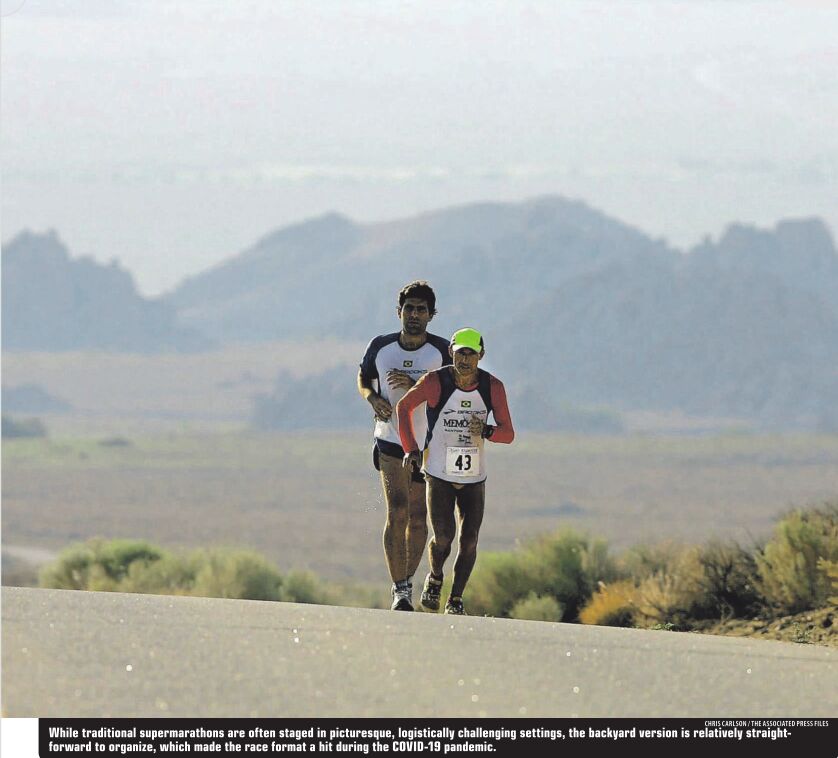
While traditional supermarathons are often staged in picturesque, logistically challenging settings, the backyard version is relatively straight-forward to organize, which made the race format a hit during the COVID-19 pandemic. CHRIS CARLSON / THE ASSOCIATED PRESS FILES
AT 51, Susannah Dyson decided it was time to start taking better care of her health. Her work as an electrical engineer had taken over her life, and she resolved to make time to exercise.
She started running, and over the next 14 years she finished many of the world’s most prestigious marathons. Then she began entering ultramarathons, races longer than 26.2 miles (42.2 km).
One Saturday last month, at 65, she ran farther than she ever had before. At the Prairie on Fire backyard ultra, a race outside Indianapolis, she covered more than 66 miles (106 km) in 16 hours.
Her pace was much slower than her usual races, but that was beside the point. In a backyard ultramarathon, runners must complete the same 4.167-mile (6.7 km) loop once each hour. If they finish early, they can rest for the remainder of the hour. If they fail to finish a lap, they are eliminated. The last runner standing wins. These races usually last for more than 100 miles (162 km) over multiple days. The record, set last year in Australia, is nearly 500 miles (805 km).
Despite the brutal format — or perhaps because of it — the backyard ultra is booming. There were at least 500 versions of the race over the last year, and there are already more than 700 on the calendar for the coming year. The races pop up in parking lots and on mixed-use trails around the United States and in some 80 other countries.
This year’s Prairie on Fire started with a few hundred runners, mostly from the local running scene. They brought friends and family members for support, set up tents with chairs and cots where they would rest between laps, then ran until their minds or bodies failed them.
“It’s a nice feeling of accomplishment,” Dyson said as she rested after about 29 miles (47 km). “I’m going to feel horrible tomorrow,” she added, grinning.
SLOW AND STEADY
The first backyard ultramarathon was organized by Gary Cantrell, known as Lazarus Lake, whose Barkley Marathons is a quirky 100-plus-mile race that has been finished by only 20 runners since 1995.
In 2011, Cantrell developed the backyard ultramarathon because the course could fit on his 140-acre farm. The first year was casual. Seeing the recent growth, “you just shake your head in amazement,” he said. “It’s so totally unexpected.”
Only in retrospect, he said, can he see why the backyard format has wide appeal. The built-in pacing, slower than the cutoff time for many marathons, has a way of coaxing out unexpected performances. Many runners are surprised by how long they can keep going. And unlike conventional races, with competitors spread out and too winded to talk, the hourly reset adds a social component — there is ample time to catch up with your Strava friends.
These races are also relatively straightforward to organize compared with the best-known ultramarathons, which tend to run through beautiful, logistically challenging landscapes like the Rocky Mountains, the Alps or the Sahara.
The simplicity and compactness of the race format made it a hit during the pandemic. TJ Dailey, Prairie on Fire’s race organizer, was putting together socially distanced virtual races before he decided to stage a backyard ultra. The first edition, in 2022, had 15 entrants. This year, 228 runners finished at least one lap, and 117 ran farther than 50 miles (80 km).
Looking out at the softly glowing tent city a few hours before dawn on the first night of this year’s race, Dailey compared the event to the Burning Man festival. Like the anarchic temporary city that rises in the Nevada desert every summer, a backyard ultra is also a pop-up community for people seeking an intense experience separate from everyday life.
‘WILLING TO BE UNCOMFORTABLE’
Prairie on Fire started with a version of the Norwegian World Cup team’s Viking chant, only for the race to begin at a near-walking pace.
Most runners employ a version of the run-walk method, combining jogging with walk breaks, but the exact pace is a personal preference. Some competitors aim to expend as little energy as possible and use almost the full hour on the course. Others will move a little faster in exchange for more time in their chair or a few minutes of sleep.
Between “yards,” as each 4.167-mile loop is known, competitors fight to keep their bodies functioning. They drink the latest high-carbohydrate sports drinks and eat comfort food like instant mashed potatoes and ramen. (Dailey’s 12-year-old daughter, Kaelynn, who covered 41.6 miles (70 km), fuelled herself in part with Nerds Gummy Clusters.) They stretch and massage themselves, and try to discern if that sharp ankle pain is simply a blister or something more concerning.
“It is unfortunately very common in the ultra world to push yourself too far,” said Carly Trulock-Quinn, 30, who pulled out well shy of her 100-mile goal once pain began to affect her stride.
Majel Wells, 48, said that in order to stay in touch with her body, she had learned to largely avoid common aids like caffeine, over-the-counter painkillers and music.
She appreciates surprising people who might underestimate her at a glance.
“I just know myself much better than I did when I was younger,” she said. “I’m better than I was because I’m more willing to be uncomfortable.”
She covered 129.1 miles (207.8 km), farther than all but seven runners, and was the last woman standing.
By the second sunset, at the 150-mile mark, the field had shrunk to five. And just before 2 a.m. that Monday, Matthew Sandlin, 42, finished the final yard by himself, a champion after 179.1 miles (288.2 km).
He said that pushing his physical limits became a way to focus his faith and to surface a side of himself that doesn’t usually play a role in daily life.
“I have this certain level of grit, or stubbornness,” he said. “And I can’t really display that in the work environment, at a nine-to-five. There’s not really an outlet for that.”
In a backyard ultra, the winner is the only runner left wondering where their limit is; they only finish one final lap once they’re the last runner remaining.
“Nothing hurt,” Sandlin said. “I was ready to run for what felt like forever.”
— NYTimes News Service