
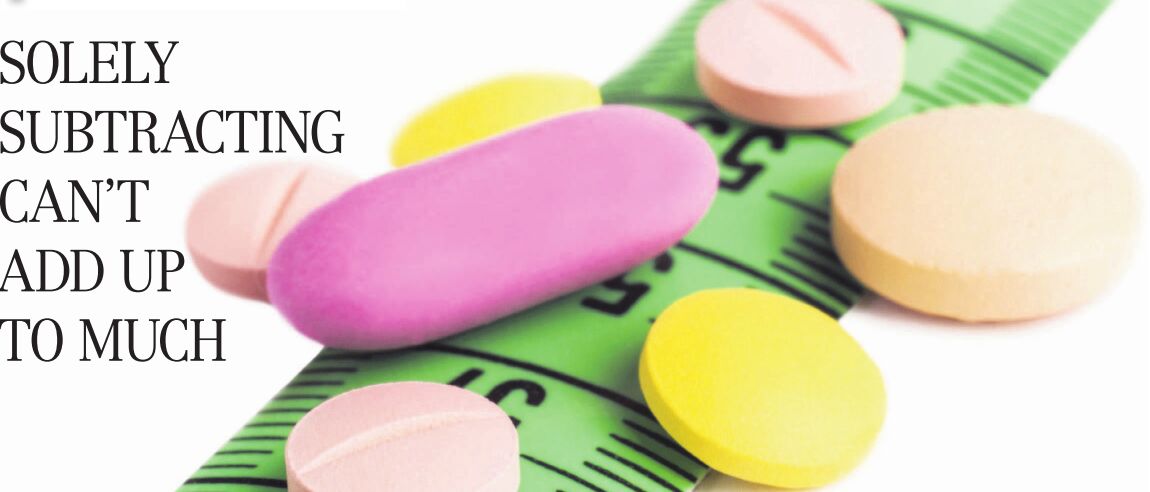
SOLELY SUBTRACTING CAN’T ADD UP TO MUCH
Popular weight-loss drugs may help shed pounds, but they don't ensure users maintain healthy lifestyle practices.
THE New England Journal of Medicine recently published the results of the biggest weight-loss drug trial yet. Retatrutide, produced by pharma-ceutical giant Eli Lilly, was taken by 2,339 adults and dropped the top-dose group an average of 28 per cent of their body weight in 80 weeks. Seventy pounds. Nearly half of them lost 30 per cent or more, which is bariatric surgery territory.
The drug isn't approved in Canada yet. But it's coming, and the numbers are going to make current weight-loss drugs seem quaint. So this feels like the right time to say something that's been bugging me.
A client sat across from me last month, 22 pounds lighter than she was in June and asked why she looked worse.
She wasn't being dramatic. Her face was drawn. She was tired by 2 p.m. every day. Her hair was thinning and circling the drain at an alarming rate. And she was, by any scale-based mea-sure, winning.
She was on the weight-loss drug Wegovy. Her doctor had prescribed it, but nobody had told her what to do while on it.
That's the gap I want to close today. Not whether you should take one of these drugs; that's between you and your physician. I want to talk about what happens after the prescription gets filled, because that's where most people go wrong.
WHAT THE DRUG DOES
Ozempic, Wegovy, Mounjaro — different names, same basic trick. They mimic a gut hormone that tells your brain you're full and slows your stomach down. Mounjaro adds a second receptor that helps with blood sugar. Retatrutide (not yet approved) adds a third, glucagon, which nudges your body to burn a bit more at rest but also raises heart rate in the process. That extra lever is probably why the weight loss is bigger. But the primary mechanism is the same: they dial down your hunger.
That's it. They don't repair your me-tabolism. They make eating less feel easier, which for a lot of people is the hardest part of losing weight. So the drug handles the hard part. Good.
But here's the uncomfortable truth about a stronger drug: the harder it pushes the scale down, the harder ev-erything I'm about to describe pushes back. A 70-pound loss not supported by a foundational plan is a bigger version of the same problem.
It won't monitor how much protein you're eating. It doesn't tell you to lift something heavier than a laundry basket. It doesn't tell you to turn off Netflix and go to sleep. It only helps regulate your appetite.
So you eat 1,100 calories of coffee and toast and feel satisfied. The scale drops. And your body, being a practical organ, starts selling off the parts it thinks you don't need.
THE PART NOBODY WARNS ABOUT
In the largest trial of semaglutide, roughly four of every 10 pounds people lost was lean mass. Not fat. Muscle, water, the tissue that holds you upright and makes your clothes fit better. The tirzepatide trial did better, closer to one in four. Still a lot.
Picture a 30-pound loss. Maybe 10 of those pounds were muscle. You're lighter, but you've got less engine. Less muscle means you burn fewer calo-ries at rest, so the same deficit stops working and you plateau. Less muscle means you handle carbs worse. And because you're eating 40 grams of pro-tein a day instead of 120, you get the fog, the flat mood, the dead afternoons.
The hair loss shows up last. It's not really the drug. It's just what happens when you lose weight fast on too little protein. The same thing happens after bariatric surgery and crash diets. It's a symptom of the diet, not anything else.
Most people I meet don't just have a too-much-fat problem. They have a not-enough-muscle problem. The drug fixes the first and, left alone, makes the second worse. I feel we're on the fast track to a muscle (or lack thereof) epidemic if these drugs go as main-stream as I expect them to.

MITCH CALVERT
FIVE HABITS TO FIX IT
I run every client through the same five things. If they're on a GLP-1, those five objectives shifts a little.
Eat enough. The drug handles calories, sometimes too well. Your job flips from trying to eat less to making sure you eat enough of the right stuff. Protein first at every meal, about 0.7 grams per pound of your goal weight. And a floor for calories. If the drug has you eating under 1,200 calories a day, that's a conversation with your doctor about dose, not a victory lap with every pound lost.
Drink water. Three litres per day. These drugs blunt thirst along with hunger and slow the gut down. Con-stipation is one of the most common complaints, and dehydration is a real risk factor.
Sleep seven to eight hours. The drug does nothing for your sleep, and some users report disruptions, particularly in the retatrutide research. But sleep is where your body repairs the muscle you're trying to keep. Researchers at the University of Chicago put over-weight adults on the same calorie-cut diet for two weeks. Half slept eight-and-a-half hours. Half slept five-and-a-half. Both groups lost the same amount of weight, about seven pounds. But the short sleepers lost less than half as much fat, and more than half of what they lost was muscle. Same diet. Same scale loss. Completely different body. You can't out-inject a sleep deficit.
Lift weights. Two or three times a week, big movements — not the fancy stuff you stop scrolling to watch on Instagram. Protein gives your body the bricks. Lifting tells it to keep the wall up. Without that signal, your body treats muscle as an expense and cuts it. The people who finish a stretch on these drugs looking strong and toned are the ones who lifted throughout. The ones who look deflated didn't.
Move every day. Eight thousand steps. On low calories, your body gets stingy with energy conservation everywhere else. You fidget less, you sit more, you take the elevator. That's your body quietly cancelling the defi-cit. Steps keep it honest.
TWO WARNING LIGHTS
Check your resting heart rate first thing in the morning before you sit up. Most watches do it for you. If it's running five to 10 beats above your normal for three days straight, you're under-recovered. Usually that's too little food, too little sleep or both.
And watch your afternoons. Fog-gy and dragging by 2 p.m. is almost always a deficit that's too deep with a diet too low in protein or micronutri-ents. Fix the leak.
THE DAY YOU STOP
In the followup to that semaglutide trial, people who came off the drug re-gained about two-thirds of what they'd lost within a year. The medication did exactly what it was built to do. There was nothing underneath it when it left.
Think of the drug as training wheels. The whole point is to take them off. If you never learn to balance while they're on, you fall the second they come off. Those five habits are the balance. You build them while the drug is doing the heavy lifting, so when the drug leaves, you don't.
That's the right way to use one of these medications. There may be a case made to use this like a medication you never come off of, but that seems premature with the data we have, and presents challenges like continually having to titrate up the dose and deal with more side effects for less payoff over time. Use that window of time you're on it where the hunger is quiet to build the habits that have been out of reach for years. The habits will sustain the results afterwards.
And the client I mentioned in the introduction? Protein first, three dumbbell sessions a week, a water bot-tle she refills three times. Four weeks later she'd lost two more pounds, which sounds like nothing. But her after-noons came back. So did her energy. And she looks like she reversed aging by a decade. Slow is smooth and smooth is fast in the long run.
Mitch Calvert (mitchcalvert.com) is a Winnipeg-based fitness and nutrition coach.