
State’s black bear kill rises to largest total in over two decades
40% above 5-year average
St. Paul — The 2026 bear season now ranks among the tops in state history, with the highest harvest totals in two decades.
Dan Stark, large carnivore specialist for the DNR, said 4,168 bears had been registered through Sunday, Oct. 18, the final day of the season. Those are preliminary results, and the tally may change because hunters can register bears up to 48 hours after harvest. Compared with last year’s total of 2,863, Minnesota saw a 30% increase, and this year’s total is up 40%
above the five-year average.
About 80% of the bears were taken during the first couple of weeks of the season. Stark said just under 1,000 bears were harvested during the last four weeks.
Only the 1995 and 2001 seasons resulted in higher harvest totals, Stark said, so this season ranks third in the state’s history.
Along with the third-highest harvest count, the state set a new record in no-quota areas. Stark said the previous record was 1,024 in 2024. In 2026, the state recorded 1,139 bears harvested in no-quota areas. In quota zones, 3,029 bears were harvested, compared with 2,086 last year.
“A bigger portion of that harvest this year is from no-quota bears. That’s a big factor in results and there are more bears distributed across the state and opportunities in the no-quota area,” Stark said.
License numbers also rose this year, with about 10,900 sold. About half were split between quota and non-quota zones. The season set a record for no-quota licenses, with 5,477 sold. Because of issues with the bear surplus sale, Stark said a few areas were oversold. The original quota was set at 5,330. The total number of tags for quota areas increased by 700 compared with 2025.
Stark said about 28,000 people applied for the bear lottery this year, continuing a trend of increasing interest in bear hunting.
“The no-quota area success tends to be lower with more licenses issued and fewer bears taken,” Stark said. “It’s about 21% compared to the quota area’s 57%. But the overall average success was 39%.”
Although the overall harvest increased significantly, Stark said much of the increase was due to bear permit areas 45, 46 and 51.
In BPA 45, which includes the Brainerd area and north-central Minnesota, the harvest increased 45%, from 187 bears last year to 350 this year. BPA 46, also in north-central Minnesota, saw an increase from 350 bears last year to 586 this year. BPA 51, in east-central Minnesota, recorded 718 bears this year, compared with 436 last year.
“That makes up a pretty significant increase just in those three areas alone,” Stark said.
Stark said one factor contributing to the high harvest this year was the increase in permits. Although he has not yet summarized the information gathered about food availability, he said poor natural forage could mean more bears were hitting baits.
Stark said the DNR has adjusted harvest quotas over the years based on population trends to improve bear hunting compared with conditions more than a decade ago and help sustain it into the future.
“The overall goal is to maintain a healthy population that’s resilient to some of these high harvests,” Stark said. “The overall trend has been a slight increase across bear range. We’ve been kind of building back up from some of the lows we saw over a decade ago.”
Stark said hunters who registered their harvest through the mobile app should double-check that the registration went through, especially if they were outside cell service or internet coverage. He also reminds hunters to send in their bear tooth if they were successful, with instructions on the DNR website.
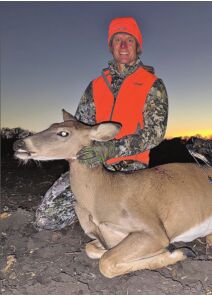
Minnesota hunters have had relatively comfortable weather conditions to hunt in this fall, and that included some temperatures in the 40s and 50s last week while the statewide archery and youth seasons, as well as the early-antlerless season in select deer permit areas, were all taking place. Total harvest through the end of the youth and early antlerless period is up about 19% from last year. Photo by Eric Morken
A big archery jump
Archers have set the tone for higher harvest with the kill up 53% from the same time last year. That includes the fact that hunters had nearly a week more of hunting to this point in 2025.
Hunters during the archery season have killed 10,825 total deer compared to 7,066 at this time last year. Fifty-three percent of this year’s archery kills have come via vertical bows and 47% have been with crossbows.
Overall, comfortable temperatures have made getting into the woods more appealing for archers this year, compared to last year when hot conditions plagued parts of the early season.
“Usually in September and early October you can be sitting in the stand in 80-degree weather and we see that in the harvest numbers,” Burr said. “They tend to drop. Weather has been good on the hunter’s side for sure.”
Early antlerless and youth seasons tally
The four-day early antlerless firearms season is open in deer permit areas that are over the deer population goal.
This year, DPA 685 was added to this hunt. A total of 26 DPAs were included in the early-antlerless season, compared to 25 last year.
Harvest from this season is up about 42% from 2025 after hunters shot 4,793 antlerless deer this year compared to 3,384 last year. This year’s total may increase a bit as deer shot later in the weekend get registered.
“I’m very happy with the number,” Burr said. “There’s kind of a worry where you introduce a new season like early antlerless and hunters get excited. It’s something new, you get out early, and then we worry the novelty wears off and you’ll see a decrease over time. But that doesn’t seem to be the case. It kind of follows the deer herd like other harvest does, so seeing that continue to be popular and show increases over the last few years is very promising.”
Totals from the youth season are up 19% as the state’s younger hunters shot 8,289 deer over the four-day gun season, compared to 6,968 in 2025.
“Looking at youth season, 48% of harvest were bucks and 52% were antlerless,” Burr said. “Last year it was about 50/50, so we saw an uptick in antlerless harvest as well for youth. Any time that we can see more antlerless harvest, especially in certain DPAs, the better for sure.”
A sign of things to come?
Burr credited weather as a driving factor in increased harvest so far for a couple of reasons.
In general, it’s been an inviting fall for hunters to get into the woods. Recent mild winters have also led to what wildlife managers say is a growing deer herd in much of the state.
Bowhunters have had a lot of days in the 60s to hunt so far, with some hotter and cooler days mixed in. Gun hunters during the youth and early antlerless season had temperatures in the high 40s and low 50s the first two days before more mild temps moved in for the weekend.
“September, October have been fairly nice. It hasn’t been too hot so that’s why we’re seeing an increase, especially in archery season,” Burr said. “And we’ve touted this a lot, but we’ve basically had three consecutive really mild winters. Some of those winters basically nonexistent, with the exception of the far northeast. That transfers to benefits for deer – higher reproduction, better survival and that holds true throughout time. You have mild winters, and we tend to see jumps in harvest.”
As long as weather does not affect hunter participation during the upcoming firearms season, Burr expects the increase in total harvest from 2025 to continue the rest of the year.
“Since 2023 we’ve slowly been bumping up and I would expect to see another bump,” he said. “Starting out really strong and having a good early antlerless and youth season speaks to that. Hopefully this trend will continue and we’ll have a good harvest this year.”