
Duck hunters await fresh birds as warm weather lingers
The midseason migration has slowed to a trickle, while low water levels complicate access to some traditional hunting hotspots.
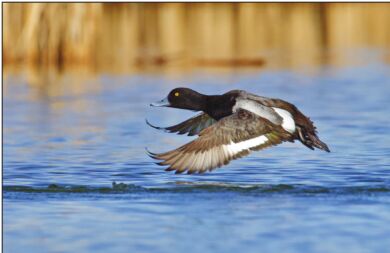
Bluebills (scaup) and other divers have been slow to migrate through Minnesota en masse this fall as well-above-average temperatures continued to dominate the region again this past week. Managers are hopeful that will change soon. Adobe photo stock
Shakopee, Minn. — If you spoke with enough waterfowlers and waterfowl managers across the state in the last handful of days, the message you heard was as clear as moonshine: The duck hunting has gotten a little stale.
Some early-season local birds have left the state, or have dispersed to other parts of Minnesota, many avoiding heavily hunted public lands and finding sanctuary in those “out-of-the-way places,” as one hunter on social media put it. A stiff northwest wind last Friday did push some new birds (ducks and geese) into the state, state officials say, but it wasn’t anything significant. And that isn’t likely to change anytime soon. This week’s forecast calls for high temperatures in the 60s and 70s across most of the state, with south and southeast winds. Not exactly the kind of weather that jump-starts a duck migration.
“After a pretty decent opener in some locations of the state, and a modest push of birds with more seasonable temperatures last week, we’ve settled into this pattern that will probably frustrate some hunters,” said Nate Huck, Minnesota DNR migratory gamebird consultant in Brainerd. “We’ve had some divers move in to traditional diver areas, along with some other ducks. But things have gotten pretty stale and that probably won’t change much with this week’s weather forecast.”
Drought
One major theme of the duck season is the persistent drought across Minnesota, particularly on the borders of Wisconsin and the Dakotas. Moderate to severe drought runs from extreme southwest Minnesota north to Polk County in the northwest – a line of border counties that traditionally has some of the best hunting in the state. Severe drought also runs from roughly the Wabasha area north to the Arrowhead region. Most interior counties are also in some form of drought, according to the U.S. Drought Monitor. The only parts of the state without drought are some counties in extreme northwest and southeast Minnesota.
The upshot for hunters is that hunting access has been difficult, though far from impossible in some areas, state officials and hunters say. The Mississippi River backwaters, especially from Hastings downstream to Winona, are low to extremely low and access is challenging. According to several reports, hunters using mud motors to access that backwaters – where there plenty of puddle ducks, incidentally – have gotten stuck.
Huck said this time of year is a challenge for waterfowlers. Still, he said, opportunistic hunters can have success. Some are, he said. His advice is simple.
“Go scout new areas,” said Huck, echoing other DNR officials and hunters. “You have to search for places that are off the beaten trail. That’s where you are going to find birds this time of year after they’ve been pressured since the opener in traditional public areas. If it’s easy to get to, everybody is already doing it. So, change what you’re doing. Until we get some weather, that’s what you need to do.”
Huck also said waterfowlers shouldn’t wait for a massive cold front to go hunt. “You never know what’s going to happen,” he said. “And you’ll never know unless you go.”
Adam Kleinschmidt, wetlands specialist with the DNR, travels a lot of for his job, often in prime duck country of the state’s agricultural region (western, west-central and southern Minnesota).
“There are just some areas as you go west that you could typically run a boat and motor where you won’t be able to this year,” he said. “It’s pretty dry, even for some kayaks.”
Some basins and shallow lakes have mudflats, some more significant than others. The “sticky mud” makes setting decoys, let alone retrieving ducks, incredibly hard.
Still, Kleinschmidt said, there are pockets of water in some counties (Otter Tail County, for one, has good water and had a significant push of divers over the weekend, including canvasbacks) where access is decent to good.
“You have to scout, and not only for birds, but for access,” Kleinschmidt said. “There are birds out there, you just have to go find them.”
That includes Marsh Lake in Lac qui Parle County, where duck numbers are good (including an influx of pintails) and where hunting pressure has been high since the opener.
Field reports
At the 7,100-acre Thief Lake Wildlife Management Area in Middle River in northwest Minnesota, DNR area wildlife supervisor Kyle Arola said hunting pressure was “light” on Thief Lake over last week’s MEA weekend compared to most years.
“We typically see more hunters when the kids are off from school, but not this year for some reason,” he said. “With the youth deer season, pheasant hunting and even fall fishing, there are a lot of outdoor activities to choose this time of year.”
Arola said DNR staff did conduct bag checks on Sunday at Thief Lake. The average, he said, was 1.5 birds per hunter. The top three harvested ducks were green-winged teal, blue-winged teal and mallards. “I’m very surprised by the lack of ringnecks and redheads,” Arola said. “Last Thursday, ringnecks were number one. They must have moved out on Friday with the northwest wind.”
For waterfowling opportunities moving forward, Arola said Thief Lake is in good condition to host migrating ducks. “We’re about two inches above management levels right now and habitat looks good,” he said. “But I don’t see much of migration happening for a while; most of this week we’re going to be in 60s and 70s with south winds. But you never know.”
Rob Baden is the DNR wildlife supervisor in Detroit Lakes. His area includes Becker, Norman and Mahnomen counties. An avid waterfowler, Baden looked at last week’s weather forecast and noticed something for Friday that all enterprising waterfowlers salivate over: a northwest wind. The ducks didn’t disappoint. He said he had a great morning on a public marsh, he said, shooting a nice mixed bag of ducks, including one scaup.
“And not a soul was around, either” he said. “I don’t think I heard another shot.”
Baden said some new birds moved into his region last week, though there are still some local mallards and wood ducks and blue-winged teal around, too. Baden said: “It’s the time of year when hunters need spend more time behind the windshield” to find pockets of ducks that are steering clear of high-pressured public areas. He also said you have to keep close tabs on the weather, like he did last week. Be opportunistic, he said.
“Overall, the hunting around here is far better than last year,”
(See Migration Page 29)
Baden said.
Last Saturday, Nick Brown, Minnesota DNR shallow lakes specialist, hunted the southside of Lake Christina in west-central Minnesota. He wasn’t alone. At least eight other groups hunted that morning too. The gunning was robust throughout the morning.
“There’s a lot of ducks on the lake right now,” said Brown on Monday afternoon. “Mid-season divers like ring-necked ducks, redheads and canvasbacks, and puddle ducks, specifically mallards, green-winged teal, gadwalls and wigeon.”
Lake Christina is currently in drawdown, which, Brown said, has helped “attract a lot of ducks.” Hunters, he said, are able to get on the water at the southwest access. “It was a great show on Saturday,” he said.
Robert Philipson, 41, who lives south of Mankato, has been hunting Swan Lake in southern Minnesota with his father since he was a young boy. They hunt the storied lake several times a year. However, last Thursday, Friday and Saturday, they traveled to north-central Minnesota to hunt some of the region’s wild-rice lakes. They typically make the trip once a year.
“It’s old-school hunting, with a lot paddling and push-poling and we love it,” Philipson said. “The hunting was pretty decent; there’s a good crop of wild rice this year. The ducks we cleaned we’re fat and healthy.”
Philipson said his son couldn’t make the trip north this year, but hunted Swan Lake on Saturday, as did many others. “He said it was pretty bad; more hunters than ducks,” he said. “Hopefully it will get better as the fall progresses and the weather changes and pushes some birds down.”
In the interim, Philipson said he’s going to concentrate his efforts on field hunting for geese in and around Mankato this coming weekend. According to several reports, the fall corn harvest is picking up across Minnesota and attracting geese, as well as some mallards.
“I have a few places lined up and hopefully we’ll get into them,” he said.
Every Thursday during the hunting season, the Minnesota DNR releases a statewide waterfowl report.
For more information about waterfowl hunting in Minnesota, including regulations, bag and possession limits, season dates and the weekly report: www.dnr.state.mn.us/hunting/waterfowl/index.html.