
Duck hunting declining, but fishing licenses holding steady
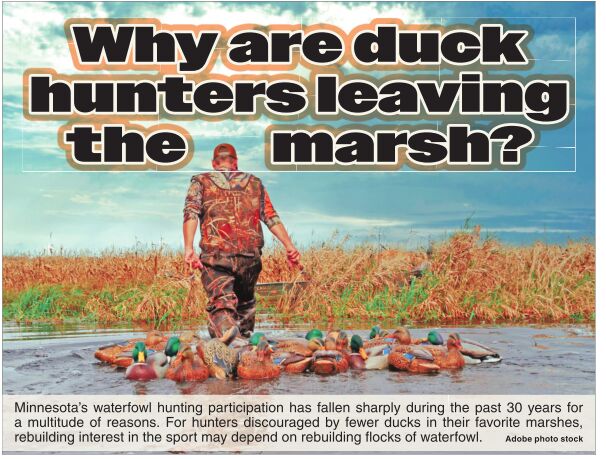
Minnesota’s waterfowl hunting participation has fallen sharply during the past 30 years for a multitude of reasons. For hunters discouraged by fewer ducks in their favorite marshes, rebuilding interest in the sport may depend on rebuilding flocks of waterfowl. Adobe photo stock
The decline in waterfowl and waterfowl hunters is apparent to most hunters. In contrast, I don’t see any obvious drop-off in numbers of fishing boats on the lakes I frequent.
To see the trend of waterfowl hunting decline in Minnesota, I plotted data on the number of Minnesota migratory waterfowl stamps sold from 1977 to 2025, which I adjusted by the Minnesota population.
For comparison, I plotted the number of resident individual angling licenses sold for the same period. There is a distinct decline in the relative number of waterfowl stamps sold over this period; in terms of actual numbers, the 60,652 stamps sold in 2025 is half of the number sold in 1977. In contrast, the number of resident angling licenses sold is fairly stable at about 8% of the population; the actual number sold has increased over time, but not relative to the overall population.
The biggest issue, then, is the decline in waterfowl. Many have explored reasons for the decline in waterfowl hunting. Most of my acquaintances cite the decline in duck numbers. One friend who regularly harvested many divers on Lake Winnibigoshish no longer finds it worth his time to hunt there. Irrespective of whether the reduced number of ducks seen is due to loss of breeding habitat, or shifting migration patterns, the effect is clear.
A guide in Nebraska told me that the 2025 duck season was the worst he’s had in 40 years. It’s hard to get motivated for a duck season given the low probability of success.
There is likely no one factor that could be “fixed” to bring back significant numbers of ducks. I’ve heard many waterfowl hunters say that what they see afield in no way matches the USFWS population estimates. Many have pointed to breeding season surveys as having flaws, regarding how birds are counted and then the numbers extrapolated to total numbers.
Some say that for mallards, the sex ratio is now 3:1 in favor of drakes, which if true could lead to plunging mallard numbers. In addition, the release of captive-bred mallards, with some genetic characteristics that are not conducive to life in the wild, probably has exacerbated their decline at least in eastern North America; F. Rohwer president and chief scientist at Delta Waterfowl says that this is not an issue, whereas others disagree.
Rohwer points to a 2002 paper by S. T. Hoekman and colleagues that claimed that 90% of the loss of ducks occurs during the breeding season, prior to southward migration. Things like low nest success (43%), hen survival (19%) and duckling survival (14%) are major factors that determine how many mallards migrate south each fall; note that hunter kill is not a major issue.
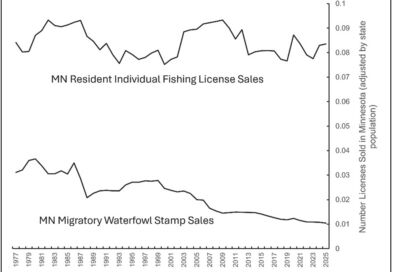
While state duck stamp sales show a steady decline in Minnesota, fishing license sales continue to hold up. About 8% of the Minnesota public buys a fishing license. Graph courtesy of Bob Zink
The reason is that hunter harvest in considered to be “compensatory,” meaning that this number of birds would have perished by other means. When hunting exceeds the ability of the population to compensate via reproduction, it’s termed “additive,” and that’s bad.
A favorite culprit of many is a potential imbalance of ducks and duck-nest predators. Of course, during the heyday of market hunting, when there were ducks everywhere, predators also existed. However, it might be that during that time there were so many nesting ducks that they “swamped out” the ability of predators to do serious harm; the technical term is “predator saturation.”
Same for passenger pigeons – they numbered in the billions, far more than predators could dent during the spring nesting season when they were vulnerable. With lower numbers of breeding ducks, they might not be able to withstand predation pressures.
It seems pretty clear that for the waterfowl hunting to recover, we need more ducks. However, the 2026 continental mallard numbers dropped by 11% from 2025, and sits at 26% below the long-term average (which did not include market hunting days!)
The states with highest waterfowl harvest include California, Arkansas, and Louisiana; Minnesota ranked fifth in estimated harvest in 2025. Delta Waterfowl says that the mallard population in Minnesota is up 47% over the last year, and the most since 2019.
The 2026 estimate is about 5% above the long-term average for the state, which hopefully is good news, but we’ll have to wait for the end-of-season hunting reports. If you’re thinking about heading west, North Dakota breeding ducks appear to have dropped almost 10% from 2026.
At least the numbers of people buying fishing licenses in Minnesota is holding steady. That suggests there’s at least enough fish to keep interest. The solution for duck hunters seems a harder nut to crack.