
Klein promises to freeze property taxes, charge fee to hire more police officers
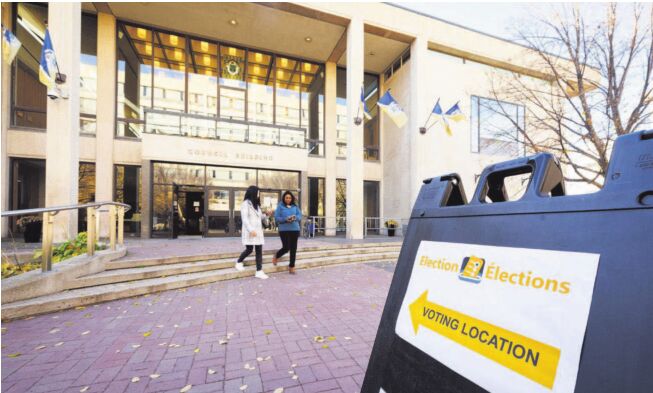
A record-high number of Winnipeggers showed up at advance polls this year. (Mike Deal / Free Press)
KEVIN Klein would freeze property taxes next year but charge homeowners a new, separate $3.99 monthly police fee, if he's elected mayor of Winnipeg next week.
Klein released his costed platform Friday, which calls for the new charge. He said it would last at least four years but is not meant to be permanent.
"I don't see this as saddling this with somebody for the next decade or 20 years. I see this as something we have to do today, to get more police officers on to the streets, that we are, right now, desperately in need of," he said.
The revenue would allow the city to hire 100 more police officers, with 50 new uniformed cops added in each of the next two budgets, said Klein.
"Every dollar collected will be dedicated to the additional officers," his platform document notes.
In years two, three and four of his term, Klein said the annual property tax hike would be capped at 2.99 per cent.
"This is a responsible approach that will move Winnipeg forward," he said.
He called his plan more reasonable for taxpayers than the 5.95 per cent property tax hike city council imposed in 2025, alongside significant increases to garbage collection fees and sewer rates.
"Households keep paying more and getting less. Sidewalks continue to be broken, infrastructure crumbling, arenas closed," said Klein.
He would ask the provincial government to approve his "dedicated police fee," even though he believes the city has the power to add it. That flat fee for all homeowners would cost "less than a Netflix subscription," he noted.
Klein also promised to complete a "line-by-line" review of every city department's budget to "challenge spending, identify efficiencies and redirect resources toward frontline services."
While he hopes to save money, Klein promised not to eliminate front-line jobs over the next four years. He did not extend that commitment to all city workers.
"For management, I can't promise that," he said.
His plan would also redirect 50 per cent of funding for Winnipeg's bike lane program to combat homelessness, improve arenas and update community centres. That would transfer about $6 million, based on the 2026 budget, he said.

Winnipeg Votes
"We need to take 50 per cent of the money we have for bike paths because that's not a critical issue in our city," said Klein.
Reducing homelessness, by contrast, is an urgent priority for many Winnipeggers, he said.
Klein's plan would also direct frontage levy revenues to improve roads, sidewalks, curbs, lanes and boulevards, not cover general city operations.
He also plans to freeze water and sewer rates, as well as waste collection fees for two years. He expects the federal government will soon grant a $500-million request to help fund the third and final phase of the overall $3.1-billion North End sewage treatment plant upgrade, which he said would allow the city to avoid further rate increases.
The plan calls for audits of the North End plant upgrade and federal Housing Accelerator Fund.
Klein is the only mayoral candidate to release a fully costed platform so far.
Scott Gillingham, who is seeking re-election, criticized Klein's financial plan as "sloppy" and "inadequate," alleging it would force him to cut spending on important construction projects and services.
"It looks, really, like it's been written on the back of a napkin. In year one, he's proposing to freeze property taxes, which means he's cutting roads' budgets, which means more potholes, less roads getting fixed," said Gillingham.
He said Klein would need provincial permission to add his public safety levy and challenged his competitor's plan to move bike lane funding to homelessness initiatives.
"A good portion of the bike lane funding is funded through the frontage levy, which has to go to roads ... By law, (the) frontage levy can only be used for roads, or road-related work, including bike lanes," he said.
Gillingham promised to release his own costed election platform on Monday. He said that will include a 3.5 per cent property tax increase in 2027, that will raise revenue to "protect" city services and the roads budget.
Elsewhere on the campaign trail, mayoral candidate Umar Hayat shared a pledge to "revamp" Winnipeg Transit, which includes offering free rides for all passengers for six months.
"Universal access could help residents financially, encourage greater transit use, and potentially reduce congestion and emissions," said Hayat.
He expects to seek funding from the provincial and federal governments to help pay for that change, as well as more provincial funding to support Transit operations.
He also promises to switch back to Winnipeg Transit’s previous bus route network, while adding a new direct route between the airport and downtown. Some riders have complained they were forced to spend more time and take more transfers to reach their destinations after a new route network was introduced last year.
Hayat said a “passenger-focused” review of the entire network would further pinpoint ways to improve all routes and connections.
He also vowed to add at least 50 heated bus shelters and implement a pilot project to test heated sidewalks near busy intersections and bus stops.
Meanwhile, a record-high number of Winnipeggers showed up at advance polls. A total of 50,767 voters took part in advance voting, up 21.2 per cent from the 41,895 who did so in 2022, according to city data.
joyanne.pursaga@winnipegfreepress.com
X: @joyanne_pursaga
A health sciences librarian at the University of Manitoba, Dingwall hopes to ensure city council decisions are backed by evidence, community input and expert advice.
She believes inadequate bus service is one of the ward’s most pressing issues, despite noting some residents saw improvements through last year’s network changes.
“For many others, it is worse service. And I hear from so many residents that the new transit system is not working,” said Dingwall.
Winnipeg Transit should add more buses and restore bus stops, especially in front of apartment buildings, to provide better service, she said.
That includes more service along Henderson Highway, to help people reach pharmacies and grocery stores, she said.
“Now (people often) have to take two buses when it used to be one and that’s definitely a barrier,” said Dingwall.
If elected, she promises to push for libraries to be open every day, expand operating hours at pools and add city support for community centre programs.
She called for “sustainability” in funding major projects, stating the city should not expand Kenaston Boulevard or extend Chief Peguis Trail until it secures money to do so, instead of simply taking on debt.
“We’ve got to find a way to pay for them first,” said Dingwall.
The Kenaston Boulevard expansion is expected to cost up to $757 million, while the city could pay up to $899 million to extend Chief Peguis Trail. In both cases, that maximum price estimate assumes the city will fund the construction solely through debt.
Tyler Andersen, an information technology consultant, said he would push for sewage, drainage and road infrastructure upgrades.
A severe June 9 storm highlighted how outdated systems put residents at risk, said Andersen, especially as climate change makes intense weather events more common.
“The infrastructure is really out of date, especially in North Kildonan but (also) across Winnipeg … I had $22,000 worth of (sewage backup) damages in my basement and I had a lot less damage than my neighbours,” said Andersen.
Voters have told him transit service is also falling short, he said.
“A lot of people are really upset because there’s a lot more transfers, there’s a lot more inconsistency,” said Andersen.
The city should boost its own Transit spending and lobby the provincial government to restore an agreement that once saw the senior government pay 50 per cent of Winnipeg Transit’s net operating costs, he said.
“A lot of people are asking for more bus stops around the high-density areas. We have to look at getting more buses on the road so that people don’t have to use an app to figure out if their bus is going to arrive in a reasonable amount of time,” said Andersen.
He also called for the city to prioritize Canadian businesses over American ones when awarding contracts, to support local jobs and “keep the money here in our community.”
joyanne.pursaga@winnipegfreepress.com
X: @joyanne_pursaga
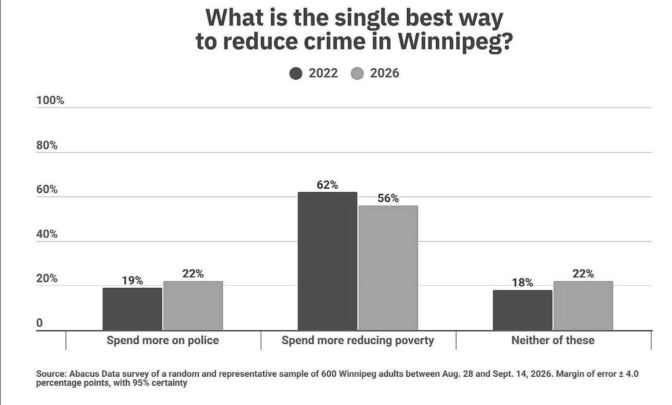
What is the single best way to reduce crime in Winnipeg? Source: Abacus Data survey of a random and representative sample of 600 Winnipeg adults between Aug. 28 and Sept. 14, 2026. Margin of error ± 4.0 percentage points, with 95% certainty
The proposal would reduce the WPS share of the city’s overall budget from 28 to 23 per cent, still well above the 15 per cent average in comparable Canadian municipalities, according to the centre.
Molly McCracken, director of the centre’s Manitoba office, said Winnipeg has lost approximately 150 community service positions over the past 25 years, alongside reduced hours at libraries and community centres.
“We’re just trying to remind people that we’ve lost a lot at the city and community services isn’t that big of a line item,” she said. “But it can have a huge impact, but not if we completely underfund it.”
The alternative budget also calls for higher property taxes, arguing decades of efforts to keep taxes low have come at the expense of municipal services and infrastructure. All three leading mayoral candidates have said they would raise property taxes, but haven’t given many details on where the additional dollars would be spent.
Meanwhile, one Winnipeg organization has developed its own alternative approach to community safety.
Mary Burton, executive director of Zoongizi Ode Inc., said the Indigenous youth organization began developing its community safety program in 2021.
“When we started this, we realized that police do not stop crime. They respond to it,” Burton said.
The organization developed a training program that goes beyond the standard 40 hours required for a security guard licence, providing another 130 hours of instruction in areas such as de-escalation and non-violent crisis intervention.
“We started out with three community safety hosts,” Burton said. “Now, we’re up to about 50, and we’re in libraries, ACCESS Centres and now the Winnipeg School Division. All of our hosts have lived experience with homelessness, with poverty, with justice or the child welfare system. Because who better to help our relatives struggling in the street than someone who has been there?”
Abacus Data surveyed 600 Winnipeg adults between Aug. 28 and Sept. 14. Results were weighted to reflect the city’s population and have a reported margin of error of plus or minus four percentage points, 19 times out of 20.