
SpaceX-Tesla merger could benefit companies, Musk’s personal fortune
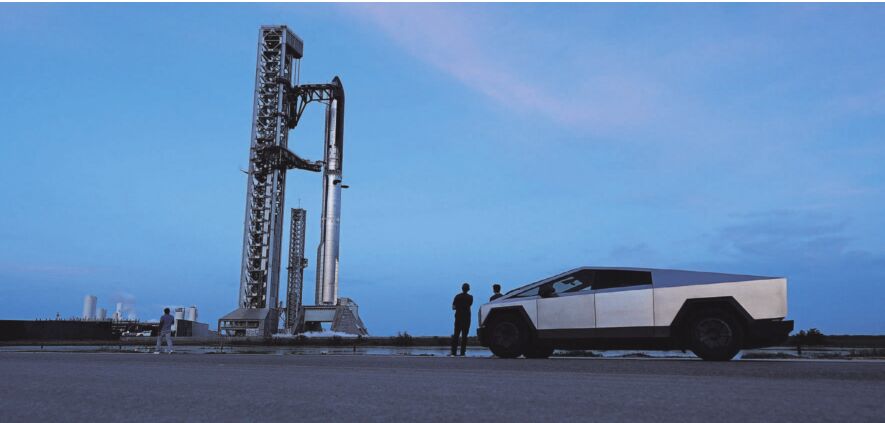
A Tesla Cybertruck sits parked near SpaceX’s mega rocket Starship on the launch pad in Starbase, Texas. The largest shareholder in both companies is Elon Musk. (ERIC GAY / THE ASSOCIATED PRESS FILES)
NEW YORK — The history of corporate mergers is littered with failure, but investors in Tesla and SpaceX seem to believe Elon Musk can pull off the biggest tie-up of all time.
Stocks of both companies rose sharply Wednesday after Musk said that each had formed “special committees” to discuss a possible combination. The deal would be worth trillions of dollars, a massive melding of the world’s biggest provider of rocket launches and satellite internet service with the second largest electric vehicle maker.
Musk says a deal makes sense given the future of both companies relies heavily on artificial intelligence. The two have already combined forces in AI chip production and a possible — perhaps impossible — project to make flying cars.
At close of trading Thursday, SpaceX had shot up 7.8 per cent and Tesla was up 3.4 per cent.
At current market values, the combination would create a US$3.5-trillion behemoth. The biggest company now on the market, chipmaker Nvidia, is valued at US$5.2 trillion.
The combination had been rumoured for months before Musk told financial analysts on a Tuesday conference call dual committees of directors had been assembled to discuss the issue. He added, as the biggest owner of both companies, he cannot interact with the committees and isn’t privy to their discussions.
Musk owns 11 per cent of SpaceX, though he holds a majority of the voting control, and 19 per cent of Tesla.
If the deal goes through, it would almost certainly top the current record holder, Vodaphone AirTouch’s deal for Germany’s Mannesmann to create a mobile giant back more than a quarter of a century ago.
In today’s dollars, that deal was worth US$354 billion.
Musk said in the conference call that there’s “lots to be gained from co-operating on developing super intelligence,” the new term for artificial intelligence he adopted after U.S. President Donald Trump last month ordered U.S. officials to use it to remove any negative connotations.
Specifically, Musk pointed to the companies combined efforts to make AI chips at their Terafab factory in Texas and the need for AI to make Tesla’s humanoid robots work. Tesla also needs AI for its vehicles to operate without drivers, a challenge that could be met more easily with a SpaceX satellite hook up. And Tesla could benefit if SpaceX’s project called Starmind is successful in putting massive data centres in orbit.
Another possible reason Musk likes a combination: it will make him richer.
A change-in-control provision in a hotly debated, potential trillion-dollar Tesla compensation plan approved last year, says many of the performance targets would be considered automatically met in certain kinds of mergers, including requirements that Tesla deliver 20 million vehicles, put a million self-driving Tesla robotaxis on the streets and deploy a million robots.
With Wednesday’s gains in Tesla and SpaceX, Musk regained the status of the world’s first and only trillionaire. Forbes estimates his net worth at US$1.004 trillion, up US$80 billion after a few hours of trading.
Most financial analysts who cover the two companies have been telling investors their shares are a bargain, according to research firm FactSet — even though by nearly all measures the shares are exceedingly expensive.
SpaceX share are trading at 100 times its expected earnings over the next year; Tesla at 170 times. Big publicly traded companies in the U.S. as measured by the S&P 500 stock index are trading at 19 times.
Many of the analysts also work for banks that hope to win business advising Musk on future deals, helping to sell stocks and bonds to finance his ambitious projects, including building “cybercabs” without steering wheels and sending astronauts to the Moon and possibly Mars.
When Musk took SpaceX public in June, nearly two dozen banks and other financial firms had a hand in the IPO, taking in an estimated US$500 million in fees.
For all the enthusiasm on Wall Street for the merger, another centre of U.S. power might have doubts: Washington.
Many lawmakers, most conspicuously Democrats, think Musk has too much power already and may want to crack down on his companies in a way that could hurt them most: federal contracts and regulation.
SpaceX has huge contracts with the federal government, and hopes for many more as NASA aims to put astronauts on the moon again soon. Meanwhile, Tesla is already the target of several safety investigations over the driver assistance software that Musk is hoping to use to turn millions of his cars into completely autonomous, self-driving vehicles and taxis.
The Democrats could scuttle things should they win big in midterm elections next month.
Musk has been the biggest donor the GOP candidates for the midterms, contributing US$276 million since July alone.
— The Associated Press