
Putin and Trump's cosy relations a recipe for disaster
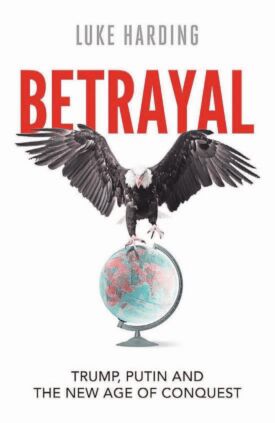
Betrayal: Trump, Putin and the New Age of Conquest. By Luke Harding. Faber & Faber, 368 pages, $45
ANY lingering doubts about how irretrievably disgraced is the integrity and dignity of the office of president of the United States are dispelled by this book.
Author Luke Harding is a veteran foreign correspondent with the Guardian, its former Moscow bureau chief and an author and co-author of several books on geopolitics, including Mafia State (2011), about Russia under Vladimir Putin. The Kremlin expelled Harding from Russia in 2011; in 2022 it placed him on an official blacklist.
Harding does a nice job of packaging the geopolitical details and complexities of the Donald J. Trump and Vladimir Putin might-is-right basis for divvying up the planet, all delivered in digestible yet never dumbed-down prose.
But it's Harding's on-the-ground reporting of the Russian invasion of Ukraine that impressively leavens the book. He seamlessly interweaves the personal struggles and tragedies of individual Ukrainian civilians and soldiers with macro-political events.
Equally illuminating is his account of the Russians' deployment of clueless North Korean troops ignorant of where, who or why they're fighting. Unsupported by air cover or artillery, and driven by political commissars, they're slaughtered in droves by Ukrainian forces. Harding's profile of a couple of bewildered North Korean soldiers, and how they came to be prisoners of war, is sad but insightful.
The betrayal of the book's title has its genesis in a 2024 Europe-and-Canada-backed Ukrainian UN General Assembly resolution that declared Russia the aggressor and invader in the Russia-Ukraine war. It passed: 93 countries voted in favour, 65 countries abstained, 18 voted against. The U.S. joined Russia, North Korea and Belarus in voting against it. (Even Iran and China had the grace to merely abstain.)
The international fallout from the U.S. abandoning a democracy to side with a dictatorship resonates even today.
"The transformation in the White House's policy towards Ukraine was so stupefying, so sudden and extraordinary, it was hard to process," writes Harding.
"In essence America had swapped sides. Under Biden the U.S. had backed Ukraine, diplomatically and militarily. Trump, by contrast, appeared to support Russia. He wanted Putin to win and Zelenskyy to lose."
He also plausibly argues that Ukraine, without adequate weaponry, has essentially thwarted the invasion for the past four years, proving the Russians could have been decisively defeated as early as late 2022, when a major Ukrainian counteroffensive, at least initially, realized territorial gains.
Harding intermittently references the "Donroe Doctrine" — Donald Trump's aggressive imperialist update of the 19th-century Monroe doctrine that asserts American dominance of the Western Hemisphere, inclusive of Canada.
But there's little about Trump's threats to "annex Canada" and make us the 51st state, or his cracks about "governor Trudeau" and "governor Carney." Nor is there mention of Trump's allegations Canada is "ripping us off" or that our trade representatives are "nasty people."
Canada gets front-and-centre treatment only in the book's last chapter. Harding leads the chapter with Prime Minister Mark Carney's celebrated speech earlier this year at the World Economic Forum in Davos, Switzerland.
Harding endorses Carney's wake-up call to the world. "Carney was blunt," he writes. "This was a 'rupture', not a transition, in global affairs, he declared. It signified the end of the 'pleasant fiction' that there was a rules-based order. Even when international law was supposed to have existed, the strongest ignored its constraints, he pointed out, while others played along because of the economic benefits of a U.S.-dominated system."
There's a parallel underlining much of Harding's account. Putin's ambition of a greater Russia and Trump's Donroe doctrine come off as one and the same mania, born of a like imperialist motive.
This is a rich and captivating account of how two dangerous guys seek to rule the world.
Douglas J. Johnston is a Winnipeg lawyer and writer.