
CHESS
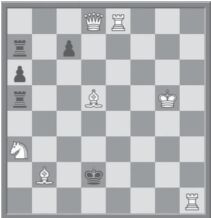
This week's problem: Mate in 2 (Guidelli)
In all the chess tournaments I have played in or watched, one stands out: the 1972 match between Bobby Fischer and Boris Spassky in Iceland.
I was a university student that year, and had a summer job working in a Copenhagen restaurant. After working for nearly three months and saving as much as I could, I headed to Reykjavik to watch four of the match games.
The match was an amazing experience on many levels, but what got me thinking back to that time was a resolution adopted last month by the International Chess Federation (FIDE) on the speed of classical tournament games. More on that in a moment, but first it's worthwhile to remember what championship chess was like in the era before digital technology.
The Fischer-Spassky match lasted nearly two months, from July 11 to August 31. Organizers scheduled about three games per week to allow for adjournments and rest days.
In every game, players had two hours and thirty minutes each to make their first 40 moves. Then they had an hour for each additional 16 moves. Each game started at 5 p.m., and generally lasted till 10 p.m. or later, with some being adjourned till the next day.
This is why I only managed to witness four of the games, even though I spent two weeks in Iceland. The slow pace of play allowed for maximum reflection and analysis by both players and spectators, and some of the best moments I remember were watching world-class analysts discussing each game in real time outside the playing hall.
Then the world changed. Attention spans became shorter, people's lives became busier, and the invention of the digital chess clock allowed for innovative time controls. Instead of a player simply losing on the spot when their flag fell on the clock, a time increment could be added after each move.
Fischer himself was an advocate of the increment, going so far as to patent a chess clock in 1988 that incorporated the system.
Today it would be unthinkable for a match to last two months or a single game to go for two days. Time controls have grown shorter and shorter over the years.
FIDE recently endorsed a proposal that would limit each player's time to one hour for the whole game, with a 30 second increment after each move. Organizers could also request events that had a 45-minute time limit, with up to three rounds per day.
"Modern life is moving faster, computer-assisted preparation has changed the way players work, and there is clear demand for more compact tournament formats," FIDE said.
At the same time, it struck a note of caution:
"If classical chess is accelerated too much, it risks losing the very quality that defines it. Classical chess is the form of the game in which players have sufficient time to think deeply about a position and make considered decisions."
This week's problem: Mate in 2 (Guidelli). Solution to last problem: 1.Qg2.