
GIANT TORTOISE IN FINE FETTLE AT 194 YEARS OLD
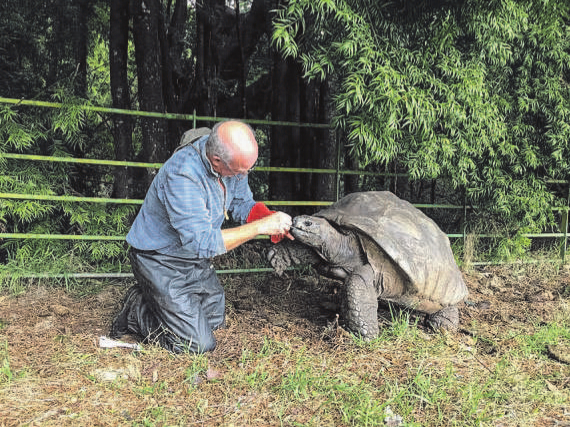
Joe Hollins, a veterinarian, takes a cheek swab from a tortoise named Jonathan. (Photo by Terry)
DR. Joe Hollins slides a thick welding glove onto his left hand and grips a cotton swab tightly in his right. He squats down to eye level with a 180-kilo, gram giant tortoise, cradles its head with his gloved hand and carefully wedges a finger into its mouth to prop open its razor-sharp beak. With his other hand, he tries to swab its cheek.
Hollins, a veterinarian, has only about five seconds to get the DNA he’s after before he risks getting punched with a thick, scaly leg.
The first swab comes back covered in half-chewed carrot — a favourite snack. He tosses it aside and tries again. The tortoise, named Jonathan, looks mildly annoyed.
At about 194 years old, Jonathan is the world’s oldest known land animal. He’s an Aldabra giant tortoise living 1,900 kilometres off Africa’s west coast on the remote island of St. Helena, spending his days on the sun-dappled grounds of the official home of the governor. (At the time of his arrival on St. Helena, he was at least 50 years old, a determination his keepers made based on size.)
Although he shows some signs of aging, like cataracts that have left him mostly blind, he still has excellent hearing and a strong libido. He enjoys greeting visitors, having his neck petted and delivering loud belches for the crowd that gathers around his paddock during mealtimes.
In June, after Jonathan was erroneously declared dead by some media organizations, Guinness World Records added him to its list of global icons, honouring his superlative status. And last week, he reached another milestone when a study announced his genome had been sequenced for the first time.
“We almost never get to study an animal this old while it is still alive,” said Steve Austad, a UCLA biologist and an author of the study, published in the journal Science Advances.
Jonathan gave scientists the rare opportunity to study what happens to an animal’s genome over the course of nearly two centuries. But obtaining the DNA wasn’t easy: Researchers were not permitted to take a blood sample, due to the risk of infection. And because the island is served by only one often delayed commercial flight per week, the swabbed saliva had to travel by boat.
Researchers were curious if Jonathan’s DNA held secrets about aging or longevity. Just think: When this tortoise was presumably born in 1832, Charles Darwin was only 22 years old and hadn’t yet visited the Galapagos Islands, where he would dream up his theory of natural selection.
After sequencing the sample, the scientists compared Jonathan’s genome with those of tortoises 100 years his junior and found some molecular differences, especially in genes involved with DNA repair and the maintenance of the protective caps on chromosomes, called telomeres. As organisms age, DNA accumulates damage and the telomeres shorten, a process thought to drive aging. The results hint that this species may have evolved to be more resilient to age-related decline, but further testing is needed.
The team also discovered Jonathan shares some genes with other long-living species like naked mole rats, which can live to 40 and rarely get cancer.
Perhaps most interesting is what they found when they looked at the tortoise’s epigenome, which is a map of the chemical tags that regulate the genome. These tags change with age and can lead to erratic gene activity. As expected, Jonathan had age-related shifts in his epigenome similar to older humans, but there was an exception. Notably, the control switches linked to mitochondria were well preserved, similar to those of a young tortoise. Mitochondria, the molecular power plants inside cells, have long been linked to healthy aging.
“Each of these long-lived species has some kind of special trick,” said Steve Austad, a biologist at the University of Alabama at Birmingham. “And some of those may turn out to be relevant to human aging.”
Jeanne Calment, for example, was the world’s oldest person at the age of 122. She attributed her long life to a diet rich in olive oil and port wine. She also smoked cigarettes. Does that mean we should all smoke and drink red wine? Probably not, research says, and we should use similar caution when drawing conclusions from Jonathan.
His advanced age could be an outlier because of his round-the-clock veterinary care, diet of fresh vegetables and protected lawn at the governor’s house.
— NYTimes News Service