
The place where golf was born
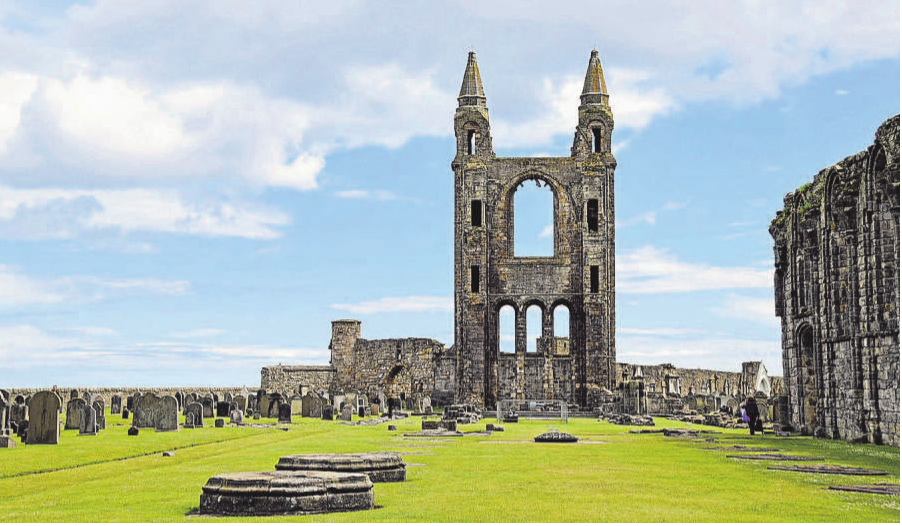
The Gothic remains of St. Andrews Cathedral still tower over the town.
Wandering through these stone remains, I come across the graves of Old and Young Tom Morris, the father and son pair who put golf on the map in the 19th century. Contemplating their headstones, it occurs to me that 1440 was also roughly the time that golf was reportedly first played on the links at the other end of town.
Afterward, I stroll to the neighboring St. Andrews Castle, another intriguing, spooky place. Begun in the 1100s and serving for centuries as the main residence of Scotland’s top clergymen, its remains sit on a dramatic headland on St. Andrews Bay. Two aspects of it are particularly compelling. The first is the “mine and counter-mine.” In short, in 1546 Cardinal David Beaton burned a Protestant preacher at the stake in front of the castle, only to be assassinated by an angry gang that then hung his body from a window. The assailants occupied the castle and settled in for a long siege, until they heard the cardinal’s avengers digging a mine into the rock to get at them. So the occupiers started a countermine, and for a year these two fervid parties chipped away at the stone until they at last broke through into each other’s wrathful arms.
Another memorable feature of the castle is the “bottle dungeon,” an eight-metre-deep hole cut into the rock that widens out into its eponymous shape. This wretched pit was where the rebels threw Beaton’s corpse, covering it in salt to “keep him from rotting.”
A chance on the Old Course: The highlight of our trip comes on the third day, when Dash wins a tee time on the Old Course through the daily lottery (unless you have a spot reserved well in advance through a golf travel operator, the lottery is the only way I know of to get on the much-in-demand course). We had entered every day, both as a pair and Dash as a single. He had been wait-listed at No. 17, but caddies had recommended that he show up at 7 a.m. ready to play. Sure enough, at 8:15 or so the starter calls Dash’s name and tells him he is next on the tee (greens fees were $355 pounds/$C670), plus 120 pounds/$C225 for the caddie. He rushes out to join three others waiting, says hello to his caddie, and promptly books his tee shot nearly out of bounds across the 18th fairway. And that, wonderfully, is almost the last bad shot he hits. Paired with another seasoned Scottish caddie, a wry and wise character named Neil, Dash plays the round of his life, into the teeth of a brutal North Sea wind.
Following Neil’s advice, Dash navigates the gorse-lined hillocky fairways, the diabolically situated bunkers and the wildly undulating greens to the tune of 40 on the outward nine holes and 41 coming home. Most memorably, with a strong following wind he bombs his tee shot on 17 over the famous railway shed, leaving only a pitching wedge to the green, ending up two metres from the cup for birdie.
“How is it possible,” Dash asks as we exit the 18th green with a brisk rain beginning to fall, “that the first golf course ever built is still the best?” “Great question,” I say. “I think we’ll have to come back to figure it out.”
— The New York Times