
START-UP CLAIMS AI-CREATED VIRUSES USED TO TREAT PATIENT
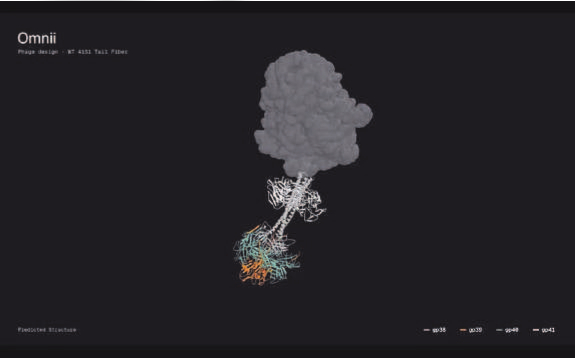
A visualization from of a tailored virus created in part with its AI model, Omnii.
FOR the first time, scientists say they have used viruses designed by artificial intelligence to treat a human patient.
Researchers announced last week that they had administered the virus, known as a phage, to a patient suffering from a deadly bacterial infection. Phages attack bacteria, and the hope is this one will kill the microbes causing the infection.
Radical Numerics, the start-up that created the viruses, posted a technical report about them on its website. But the company declined to provide information about the patient or the doctors running the trial, citing confidentiality requirements.
The report has not been peer reviewed or published in a scientific journal. Company officials said the trial had been authorized by the U.S. Food and Drug Administration.
“We take our responsibility to protect patient confidentiality and maintain the trust of our clinical partners extremely seriously,” said Eric Nguyen, CEO of Radical Numerics. “We intend to publish our scientific findings through peer-reviewed research, with any future disclosure of clinical details subject to appropriate consent.”
Outside experts greeted the news with curiosity, and a wait-and-see attitude. “If it works, that’s incredible,” said Michael Baym, a microbiologist at Harvard University who was not involved in the research.
If the experiment succeeds, it could point to a new way to use AI in medicine, providing individualized treatment to target even the most resistant bacterial infections.
Baym said he would reserve judgment until the treatment is finished and it becomes possible to examine just how novel the company’s viruses are. “My impulse is to be skeptical,” he said.
AI-designed viruses may be new, but phage therapy dates back more than a century.
Now, as antibiotic resistance becomes a growing problem worldwide, the treatment has had a renaissance. In the U.S. and elsewhere, clinics specializing in phage therapy have opened to help patients struggling against infections that resist multiple drugs.
But this treatment is much trickier than popping a few pills of penicillin.
Each type of phage infects only a limited number of bacterial strains. Once doctors get hold of one, they have to screen the virus to see if it has a chance of working against their patient’s infection.
“Hunting for phages is remarkably time-consuming,” said Dr. Marisa Azad, an infectious disease clinician at the Ottawa Hospital who is working on a collaboration with Radical Numerics.
But the emergence of AI has given scientists another idea: design new phages, customized to fight the particular bacteria infecting a patient.
In 2025, researchers at the Arc Institute in Palo Alto, Calif., created an AI model called Evo 2, which they trained on millions of DNA sequences, including phage genomes. They prompted Evo 2 to make new genomes similar to those in a group of phage species.
The AI generated 700,000 virus genomes. The team synthesized DNA molecules from 285 genomes and inserted them into bacteria. The researchers found that 16 of the genomes gave rise to viable viruses.
Three members of the Evo team, including Nguyen, left to found Radical Numerics. In June, the company unveiled a new AI model, called Omnii, based on some of the same principles as Evo, and is now using it to tackle a range of challenges, including the first trial of AI-designed phage therapy.
The researchers created variations of a phage called T7, which only infects E. coli. To infect a bacterium, T7 lands on its surface, using its legs to anchor in place. It then injects its DNA into the cell. Once researchers were confident their strategy had worked, they partnered with doctors treating a patient with a stubborn E. coli infection.
The researchers said they had trained Omnii with information about the resistant strain and told it to design T7 phages with legs that could grab onto the bacteria.
After running tests to make sure the phages were safe, Radical Numerics presented them to the doctors. The FDA authorized a trial.
It will take a while to know if Omnii’s novel phages succeed. If the trial is successful, Nguyen hopes the company can help speed phage therapy by cutting down the time it takes to create a new virus tailored to each patient’s infection.
“We think we can get it done in days,” he said.