
Data centre monotone: grey paint has never had it as good as in AI boom
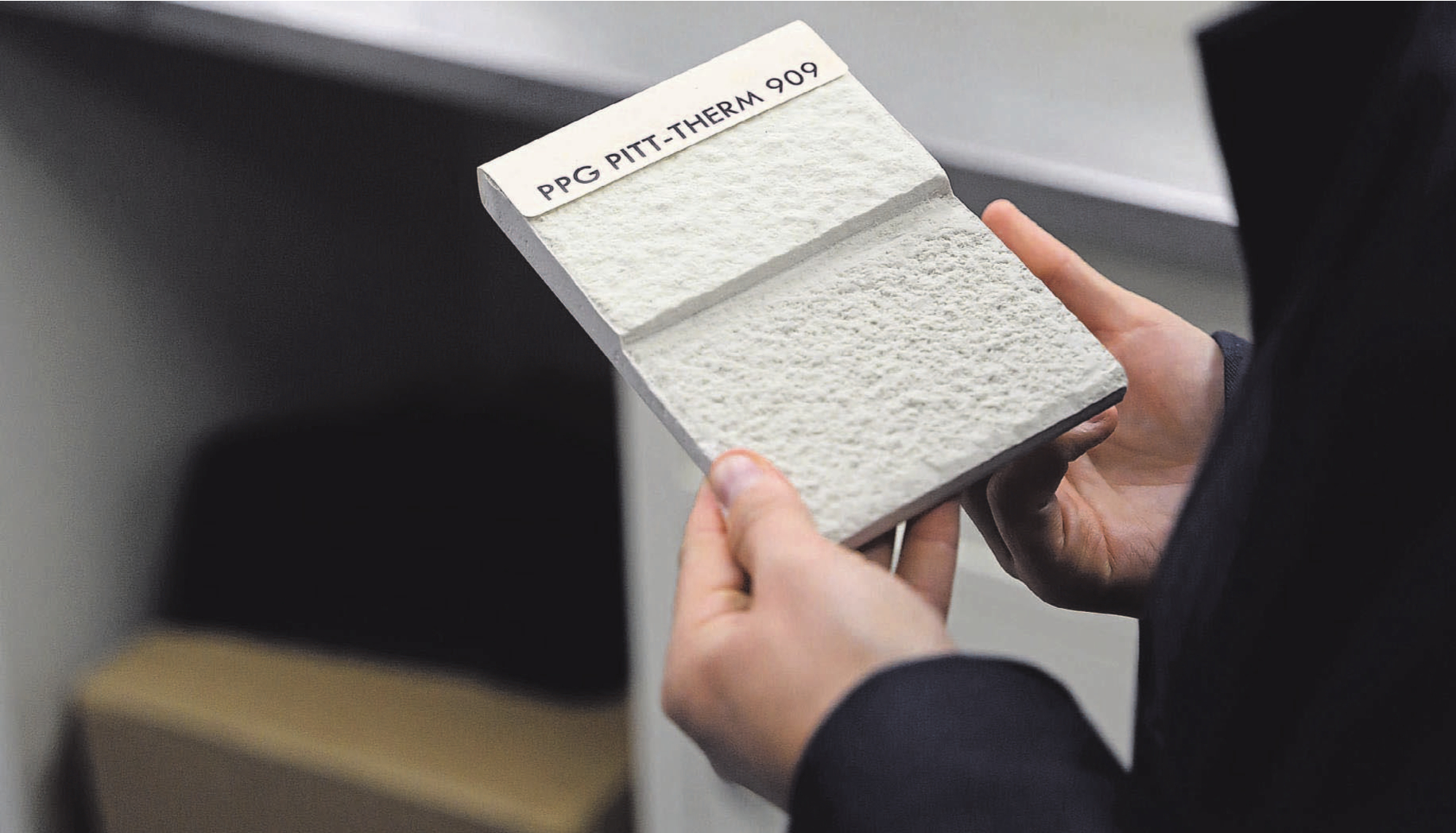
An employee holds a sample of PPG's Pitt-Therm 909, an insulation coating that keeps water pipes in data centres cold and prevents condensation from dripping onto electrical equipment. (JUSTIN MERRIMAN / NEW YORK TIMES)
PITTSBURGH — In a concrete building known as “the bunker,” researchers at PPG, a US$24 billion company that makes paints, aimed torches at steel panels that were covered in a grey coating.
Paul Fenton, a PPG chemist and engineer, held up one panel after it had been blasted with flames. The paint had swelled from one millimetre thick into a black crust nearly 10 mm tall. That meant the coating had done its job: the thick crust had kept any fire from reaching the underlying steel and softening it.
“Just like a toasted marshmallow likes to expand,” said Fenton, who wore a lab coat and safety goggles over wire-frame glasses. The trapped air, he said, “keeps everything cold.”
The paint that Fenton showed off, called Steelguard 951, has become one of PPG’s flagship products for data centres — and its sales have boomed. As Microsoft, Google, Amazon and other tech giants have raced to build the computing sites powering the artificial intelligence frenzy, PPG’s business has also soared.
The Pittsburgh company said it expected its paint sales for data centres to triple this year from last year. That would far outpace the company as a whole, whose total sales grew seven per cent to US$4.5 billion in the most recent quarter.
“I’ve never seen a boom as big as this,” said Jenn Solcz, PPG’s vice-president of protective and marine coatings for the Americas, the business that sells fireproof and rust-resistant paint for buildings, bridges, plants and marine vessels.
In other words, the AI surge — which has minted fortunes for chipmakers like Nvidia and AI labs like OpenAI and Anthropic — has now reached even ordinary goods. As data centres sprout everywhere, they are boosting sales of not only paint but also gravel, which goes into the concrete for their foundations and floors, and wires and cables to carry electricity and data to thousands of servers, creating a long tail of unlikely winners.
In the paint industry, the data centre effect has been acute.
Sherwin-Williams, PPG’s biggest rival, said its paints go into nearly every corner of data centres, from steel beams to server racks. In July, Heidi Petz, Sherwin-Williams’ CEO, said sales in its protective and marine business were benefiting from data centre construction and had risen by a mid-teens percentage from a year earlier.
“Speed matters,” Petz said. Sherwin-Williams calls itself a “single partner” that is a one-stop shop for data centre paints.
Matthew Giddings, who helps manage data centres at the commercial real estate firm JLL, said paint was particularly important because it helps with fireproofing in electrical rooms and reducing static electricity. Paints are everywhere, “from the walls to the coatings on the roof to the coatings on the steel, as well as coatings on the exterior of the building,” he said, and can total US$3 million to US$8 million for a single building, though that is a sliver of construction costs.
But the paints are not glamorous. Most are just different shades of grey (PPG names them light grey, grey, dark grey). Tech companies are painting grey concrete and grey steel with more grey, partly because there is hardly anyone around to see it. Data centres are mostly filled with machines, not people, Solcz said.
She said aesthetics were “not really top of mind for our customers and the data centre owners and architects and engineers that we speak to.”
PPG was founded in 1883 as the Pittsburgh Plate Glass Co., originally a maker of glass. It later grew into one of the world’s biggest paint companies, offering brands like Glidden, which was often found in the aisles of Home Depot. In 2024, PPG sold its U.S. and Canadian paint-store business, including Glidden, and now mostly serves other businesses, coating cars, airplanes and beverage cans.
PPG doesn’t like to call its products paint, though. Its executives said the company sells “coatings,” which include a primer to grip the steel, a working layer that does the protecting and a topcoat for the finish.
“It’s not like going in a store and buying a coat of paint and putting it on the wall,” said Amy Ericson, a PPG senior vice-president.
PPG’s headquarters, a cluster of glass spears, stand out in downtown Pittsburgh’s skyline and are a few blocks from PPG Paints Arena, home of the Pittsburgh Penguins hockey team. Its coatings are developed 20 kilometres away in the suburbs at the Coatings Innovation Center, a campus of mirrored buildings that includes “the bunker.” On the lawns, wild turkeys wander and sometimes fly into the windows.
About three years ago, after OpenAI released ChatGPT, executives at PPG noticed a wave of announcements for new data centres and chip plants, and its customers — contractors, steel fabricators and equipment makers — were suddenly bidding on data centre jobs.
PPG went after the opportunity, too. Data centres go up fast, in about a third of the time of a typical infrastructure project, Solcz said. So the company set up a team devoted to tech giants and another that works with architects, engineers and builders before construction starts so that its paints would be written into a project’s list of approved materials from the get-go.
At a trade show in Washington in April, PPG rolled out a package for data centres. It included paint that keeps steel from buckling in a fire, primers to prevent steel from rusting, flooring that keeps static electricity from damaging equipment or sparking fires, and coatings that block electrical interference between machines. The flooring was developed with data centres and chip plants in mind, Ericson said, while the other parts of the package were existing products that the company adapted for the AI sites.
PPG also makes coatings for more than 75 data centre components, including the housings of security cameras and cooling equipment.
The company’s coatings have been used in data centres from Brazil to China, but more than half the sales activity has been in the United States, Ericson said. While measuring the number of data centres is difficult, the United States has about 5,500 of them, about 10 times the next closest country, according to Stanford University’s Artificial Intelligence Index Report.
Data centres are still a small slice of PPG’s business, making up a low-single-digit percentage of sales in two parts of the company, executives said. Ericson said she and her colleagues “will definitely move up” and expects data centres to grow “multiple times” faster than other infrastructure markets.
The business faces some bumps. Some data centre projects have been delayed as they wait for power, Solcz said. Shortages of transformers and other electrical equipment have stretched out construction timelines. And local opposition to the projects has become hard to ignore.
Ericson said the backlash was for tech companies and utilities to handle.
“It’s up to them to manage those conversations,” she said.
— New York Times