
Seven takeaways from the King of Sitcoms’ new memoir
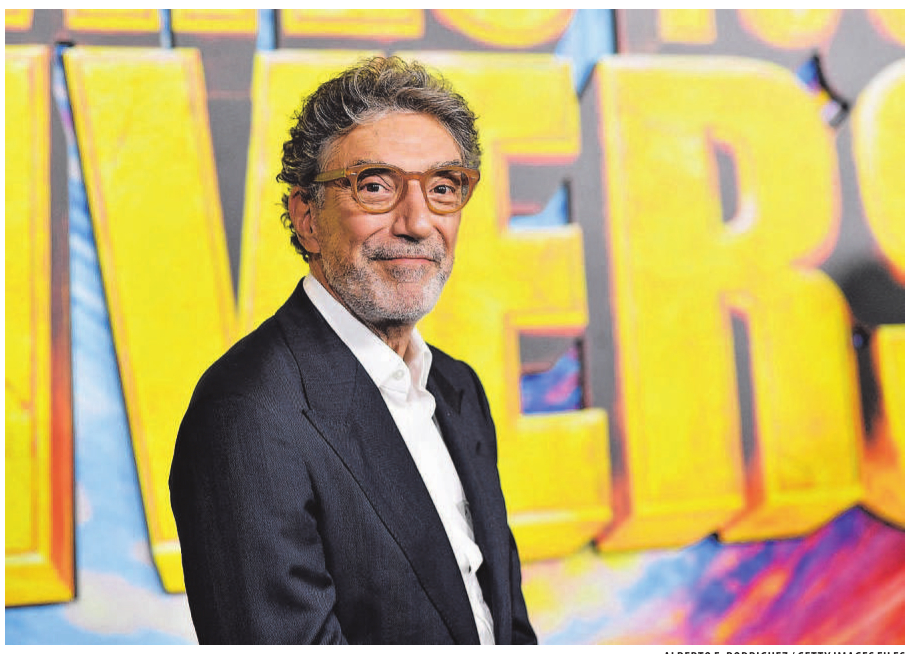
Chuck Lorre helped create sitcoms such as Dharma & Greg and Two and a Half Men. ALBERTO E. RODRIGUEZ / GETTY IMAGES FILES
CHUCK Lorre may be the wildly successful television writer and producer responsible for The Big Bang Theory, Two and a Half Men, Mike & Molly and other hit shows, but in his new memoir, Sitcom, he labels himself “an alcoholic, acid freak, pothead, college dropout, failed musician and failed cultist.”
To much of the world, he is, more simply, “the king of sitcoms.”
The book, which was released last week, recounts the bitter feuds, the dead-end projects and the dust-ups with Roseanne Barr, Charlie Sheen, Anna Faris and others that have animated Lorre’s long career.
“This is a memoir,” Lorre writes. “It’s how I remember it.”
Using an expletive, he adds: “If you’re mentioned in these pages and take issue with my recall, I can only say, write your own” book.
Here are seven takeaways from the memoir.
He spent years as a Scientologist
For a decade, Lorre writes, he belonged to the Church of Scientology, having an out-of-body experience at one of his first meetings (“Chuck has gone exterior!” the session’s leader exclaimed). He soon signed a billion-year contract with the church, pledging to help free immortal spirits known as thetans from their “feeble meat bodies.”
When Lorre developed ulcerative colitis, and his father was dying from heart disease, Lorre assumed Scientology would heal them both.
“To this day, I carry a lot of shame and regret,” he writes.
He admired Roseanne Barr but not Tom Arnold
Lorre, who wrote for Roseanne when it was the No. 1 show on television, praises Barr as a “world-class standup, with a great eye for talent.” But he claims that Arnold, an executive producer of the show, habitually demanded that his name be put on other writers’ scripts — “as if Tom had written them.”
Writers were “ordered to do this on many occasions,” according to Lorre.
Arnold has denied the allegation. “I never would put my name on a script” that Lorre had written, he told Entertainment Weekly.
He says Cybill Shepherd became a different person
At the start of Season 2 of the 1990s sitcom Cybill, which Lorre developed for Shepherd, she became a “different person,” he writes.
According to Lorre, Shepherd had been “wonderful and supportive” during Season 1, but then she “made her toady manager a co-exec, and angrily demanded complete control of the stories, scripts, casting, cameras, lighting, editing and probably craft services.”
As Lorre recounts, he was soon fired from the show.
Representatives for Shepherd did not immediately respond to requests for comment Sunday.
His feud with Charlie Sheen prompted death threats
Lorre recalls that in the last scene he shot with Sheen for Two and a Half Men, the actor could not remember his lines and had to hold onto furniture to stay upright.
“It was clear to everyone that this man, whom we’d all grown to love, was in trouble,” Lorre writes.
In 2011, after production was halted and Sheen fired, the actor sued Lorre and Warner Bros., the studio behind the show, for US$100 million. The parties eventually settled.
“For my entire career, I had been happily anonymous,” Lorre writes. But suddenly, he adds, “There were death threats. I needed police protection.”
He didn’t want Anna Faris in Mom
Lorre writes that he was hesitant to cast Faris as the lead in Mom, a sitcom about a newly sober mother.
Faris left the show in 2020, after seven seasons, to “pursue new opportunities,” according to a statement at the time.
“As the years went by, it became apparent that my initial reluctance to hire Anna was, in fact, correct,” Lorre writes, somewhat ambiguously. Faris departed, he adds, for “mysterious reasons that were not mysterious to anyone on the show.”
Faris, who has struggled with alcohol and depression, said on social media that Lorre’s comments had hurt her.
“I’ve been sober for a year and a half,” she wrote. “I was on a show about recovery and then lived it.”
Big Bang actors scoffed at taking a pay cut
According to Lorre, after Melissa Rauch and Mayim Bialik joined The Big Bang Theory, the original cast was asked to take a 10 per cent cut from its million-dollars-an-episode salary.
“They were outraged that they would even be asked to take a small cut in order to reward the two newer cast members,” Lorre writes.
Of the cast, which included Jim Parsons and Kaley Cuoco, Lorre says that “only a few don’t return my calls.”
He attributes Donald Trump’s election to a Writers Guild strike
“I’ve often blamed the WGA 2007-8 strike for bringing about the end of democracy,” Lorre writes, referring to the Writers Guild of America.
As he puts it, the strike of about 12,000 movie and television writers prompted networks to air “ridiculous” game shows that were not covered by WGA contracts. Lorre specifically cites The Apprentice, which put its host, Trump, into millions of homes.
Without the strike, Lorre argues, Trump would never have made it to the White House.
“History may write the story differently, but that was how I saw it unfold,” Lorre writes.
— New York Times